Showing posts with label romance. Show all posts

Friday, July 29, 2011

Rebecca (1940)

I love this movie. Joan Fontaine plays the second Mrs. de Winter, never given a first name in either the book by Daphne Du Maurier or the movie. While working as a companion to an elderly rich woman, the second Mrs. de Winter meets Mr. de Winter at a resort in Monte Carlo. He is moody and mysterious from the moment she meets him, an encounter during which he appears to be about to jump off of a cliff. She is completely unsure of what to make of him or if he even likes her. She is taken by surprise when he proposes marriage to her rather than lose her, when her companion packs up to sail off to New York.
When the second Mrs. de Winter arrives at the luxurious Manderley with her new husband, we find out why it is that she has no name of her own. She is living in the shadow of the first Mrs. de Winter... Rebecca. She is also at the whim of the creepy Mrs. Danvers, who came to Manderley with Rebecca and has remained devoted to her even after her assumed death in a boating accident. Mrs. Danvers is not so happy to see a new Mrs. de Winter taking Rebecca's place. And Mr. de Winter is too moody and busy to notice what is happening to his new wife. Or does he regret having married her at all?
Really the only thing that annoys me in Rebecca is the way Mr. de Winter treats his new wife from the moment he meets her. I know he is supposed to be a damaged, grief-stricken man, but being damaged and grief-stricken are more handy for explaining away intense moodiness than for explaining away why he thinks his new bride is a little child.
(1)"I'm not hungry."
"Eat up like a good little girl."
(2)He hides her tennis racket behind a plant after declaring they should go for a drive.
(3)"Stop biting your nails."
(4)"I'm asking you to marry me you little fool!"
But the future Mrs. deWinter does not seem to mind any of this. It seems to be what she expects. It is only the intense moodiness that seems to get her down. I suppose I should just be happy to be a young woman in the 21st century. Three stars, and I want Joan Fontaine's wardrobe from the movie. I would definitely see this again someday. It also makes me want to reread the book.

Sunday, April 25, 2010

Flying Down to Rio (1933)

Ah, movies from the thirties. This is what I should be watching more of. Roger (Gene Raymond) is the conductor of a band and quite a player. When he spots Belinha (Delores Del Rio) winking at him from her table during a performance, it doesn't take him very long to leave the conducting to Fred (played by Fred Astaire) and sweep her up into his arms for a dance. News travels fast throughout the hotel. When the first comment, that Belinha, the niece of a wealthy Brazilian woman, is dancing with a musician, eventually reaches Belinha's aunt, the comment has run through the rumor mill and turned into "Belinha is dancing with a gigolo." The aunt rushes down to the dining room to put an end to the dance, and a romance/battle of words has begun. I was loving the movie... the first pairing of Fred Astaire and Ginger Rogers, funny banter, amazing hats...
I was so happy... until I got to the spanking and the racism, all of which happened within a span of about five minutes. I will explain:

The spanking: Belinha needs to get home to Brazil fast. Her father needs her. It just so happens that Roger is a pilot, and that he and the band already happen to be going to Rio to play at the opening of a new hotel there. Roger convinces Belinha to fly in his two person plane (although he at first doesn't tell her he is the pilot and disguises himself in his flying gear so her aunt will let her go with him). Belinha is perfectly happy to discover that Roger is the pilot, but when Roger has to make an emergency landing on what they believe to be a remote desert island, all turns sour between them. Roger makes his engine trouble last by purposely losing an essential hose. Then he plays romantic music to get Belinha to make out with him. And then... she says something along the lines of, "No no no...I cannot do this...My family has arranged a marriage for me...I am engaged...We must never see each other again." Roger doesn't take well to Belinha's protest, Belinha slaps him, and then he throws her over his knee and spanks her a whole bunch of times reprimanding her for telling him off. Needless to say, when they have to spend the night on the island, she stays far away from him.

The racism: The morning after the spanking, Belinha looks into the trees and sees four or five black men looking back at her. She runs into Roger's arms screaming about wild men and cannibals. When Roger goes back to investigate, he finds out that she was not seeing cannibals, she was just seeing resort employees. They are in Haiti right next to a golf resort. This was supposed to be a funny joke.

The rest of the movie did have more entertaining moments, though. The hotel happens to be owned by Belinha's father, Roger happens to be friends with the fiance, and Fred Astaire and Ginger Rogers dance, all while Roger and Belinha spar and can't take their eyes off of each other.
The best part of the movie was definitely when the band saves the hotel by creating the most spectacular opener ever: scantily clad girls dancing and doing acrobatics on the wings of planes in flight. At one point some of their clothes are even carried off by parachutes. At one point one girl almost plummets to her death and has to be caught by people on the plane below. Video below:
I also love the way in which Belinha's fiance finally gives her up...a parachute is involved. Two stars for silly acrobatics and fun. I could see myself watching this again, despite the horrifying parts.

Wednesday, December 30, 2009

It's a Wonderful Life (1946)

"I wish I had a million dollars... Hot dog!"

"Buffalo gals won't you come out tonight..."

"She lights up like a firefly whenever you're around."

"A toast! A toast! A toast to Mama Dollar and to Papa Dollar, and if you want to keep this old Building and Loan in business, you better have a family real quick."

"George Bailey lassos stork!"
"What're'ya... You mean you're... What is it, a boy or a girl?"
"Mmmm-hmmm!"

"...and are the local yokels making with those David and Goliath jokes..."

"Well, you look about the kind of angel I'd get. Sort of a fallen angel, aren't you? What happened to your wings?"

"Strange, isn't it? Each man's life touches so many other lives. When he isn't around he leaves an awful hole, doesn't he?"

"Merry Christmas, movie house! Merry Christmas, Emporium! Merry Christmas, you wonderful old Building and Loan!"

"Teacher says, every time a bell rings an angel gets his wings."

"Remember, George: no man is a failure who has friends."

...and of course the original Ernie and Bert. Four stars. Whether I see it next December or not, of course I will see it again.

(Yes, I know the pictures aren't all from the same scene as the quote... It's hard to find exactly what you want out there...)

Sunday, December 27, 2009

The Apartment (1960)

I love Jack Lemmon. He really makes this movie. He plays Bud Baxter, an insurance clerk who lends out his apartment to higher ups in the company so that they have a place to bring their mistresses. Lending out your apartment to philandering executives is hard. You never get to sleep. Even if you have a bad cold, you're stuck outside on the cold stoop waiting for your keys to be returned. The best parts of Bud's days are his conversations with Fran (Shirley MacLaine), the elevator operator at his insurance company with whom he is falling in love. When Bud finally receives the promotion he's been hoping for, he tries to get out of the apartment game, only to be forced back in by the philandering head of the company Mr. Sheldrake (Fred MacMurray), who cannot be refused. Matters become worse when the different threads of Bud's life start to come together in surprising and sad ways. I wish I could say that hilarity ensues, but I don't think hilarity is the right word...

...from a suicide attempt to Jack Lemmon straining spaghetti with tennis rackets... what is this movie? The box says romantic comedy. There is certainly a lot of comedy. But is it really a romantic comedy? I do not know. I do know I enjoyed it, though. Three stars, and I would see it again.

Monday, November 30, 2009

Pagan Love Song (1950)

I am now the proud owner of TCM Spotlight: Esther Williams, Volume 2. The Box Set. Thank you Mom and Dad. Prepare for silliness.

My brother Jeremy very reluctantly sat down to drink tea and watch this movie with me when I received the box set...

Mimi (Esther Willimas) is a beautifully tanned, white resident of Tahiti. She longs to leave the island to find a higher calling than living in paradise. She already has a boat ticket away. Hazard Endicott (Howard Keel) arrives on the island of Tahiti (Hawaii) to take hold of a plantation he has inherited. When he first sees Mimi she is in a canoe with her friends. He mistakes her for a native islander and tosses coins for her to catch, while speaking to her in really painfully slow and loud English. Mimi decides to mess with him, adopting an island accent and pretending to be what he thinks she is.
***Jeremy rolls his eyes.***

Endicott hires Mimi's two friends (one of whom is a very young Rita Moreno) to be his housekeepers (although he really wanted to hire Mimi). He is surprised by how small and run down his plantation is, but his new workers tell him it will look great when it is cleaned up. Endicott sings a song about the "house of singing bamboo."
***Jeremy snorts.***

Endicott comes to love his new house and the island. He sings a song involving lines like "How-dee-doo" and "You are well I trust?"
***Jeremy laughs.***

Endicott sings a reprise of his "House of Singing Bamboo" song while holding a pig in his lap.
***Jeremy tries to leave, but is is convinced to stay at least a little longer and finish his tea.***

Endicott finally discovers that Mimi is not really a native, when she invites him to a party at her house. He shows up in island attire, only to feel out of place when he is surrounded by white people in fancy suits and dresses. Endicott and Mimi fall in love, and Mimi's family become hopeful that she will stay on the island to be with him.


Endicott ends up with three island children staying with him, and he sings with them about etiquette.
"Etiquette, etiquette, always fold your serviette..."
***Jeremy raises his eyebrows and says, "Okay Jess, enjoy." He leaves.***

And so on, with some twists and turns, one involving the native workers leaving Endicott's coconut crop outside where it can rot in the rain and him getting very very angry. It was not as much fun to watch once Jeremy left. He didn't even get to see the synchronized swimming. Not the real swimming and not the fantasy swimming.

I feel like I've been typing this a lot lately, but one star. It would be hard to have a good movie with silly, happy islanders, some of whom are probably white people with their faces painted. Oh my. I may someday watch it again, though, because as with my least favorite Cary Grant movies, I do own it.

Thursday, August 13, 2009

The Greatest Show on Earth (1952)

Tivo's description of this movie says "Action Adventure (1952) Betty Hutton, Charlton Heston, Cornel Wilde, Dorothy Lamour. A high-wire artist, the girlfriend of a circus manager, falls for a French aerialist." How it failed to mention Jimmy Stewart as a bad clown named Buttons who just happens to have learned enough about medicine in the Navy to save the circus manager's life at a key moment in the film is beyond me!
Let me repeat this slowly:
Jimmy Stewart.
In clown costume for the entire movie.
Playing Buttons the bad clown.
Who is secretly a surgeon.

There you have it, the reason to watch the movie, right there, nothing more required...but there is quite a lot more that is offered.

Oh what else? It's a musical. It's a big schmaltzy expensive costume musical with live animals and costumes that would shame Las Vegas showgirls. And this is what TCM describes as "Action Adventure"? (I happen to know that the program information on Tivo is usually supplied by the network....)


Okay, okay, all the music is diegetic, they sing as part of the circus, sing to cheer themselves up or to advertise the show - no-one sings a story or a monologue or a line that could have been spoken - but still - a coordinated number with dancing girls swinging from pineapple-bedecked ropes is quite, quite good.

By the way, that number would be, according to the ringmaster: 'The luscious Phyllis dances and sings to the sultry strains of Lovely Luawana Lady!" (Dorothy Lamour plays Phyllis)

Because Hawaii was only recently made a state we had to humiliate it, right? Like some kind of national hazing ritual?

On the more modern tip, the lyric "they don't pack that wicky whack" could easily be sampled for a hip-hop track - Diddy is probably all over it already.

WHAT is not to love about a circus movie? It allows people to say lines like
"You've got sawdust in your veins" and
"The only thing about you I'm interested in is your elephants" and
"When I kiss you, I need to have my feet planted firmly on the ground"
and while we're quoting favorite lines:
"I've never run from a fight" "and I've never lost one"
"What does a girl have to say to make a blind man see"
"Be careful of that halo, sister, it's phony, it'll slip and you'll be wearing it around your neck"
"Don't believe everything you hear, it's only half of what you see."
"Is that a professional opinion?" "That's a clown's opinion!"

The plot is thick - there's a rival circus named the Columbia, a crooked carnival games mobster, a jealous showgirl rival of the "high=wire artist" (who also does trapeze, by the way, so I'm not sure why she's a "high-wire artist" in the description). There is a german elephant-trainer who is in love with the showgirl rival, there is the crazy french aerialist who is completely obnoxious and deserves to fall and break his stupid arm.

Then of course there is a clown with a dark secret and a cute little dog (possibly named Squeaker?).

The aerialist tries a trick without a net to show off for the high-wire artist and ends up falling. The high-wire artist falls in love with his derring-do and leaves the poor hard-working sullen Charlton Heston - I've never liked him in anything but the aerialist is so arrogant and obnoxious it really makes it easy to love him. After this the movie goes on for another hour - the plot twists and twists again - the rival goes for the dumped circus manager, the high-wire artists chases the aerialist, a detective comes looking for the clown - and on and on...ending with a train crash in which a leopard escapes making me decide that this movie is the other side of the "Bringing Up Baby" story - remember the escaped leopard? It's dangerous? It escapes from a train that is crashed? This could be that leopard! I choose to see it that way.

They must have shot a lot of the crowd scenes in a hangar on the lot because the crowd has some stars in it (I spotted Bob Hope at one point) and I'm sure some executives if I knew who to look for. They must've hired some circus people to do the acts and filmed those, but they also used a LOT of green screen. A LOT. It's pretty entertaining to speculate on why - I mean the effects shots are obvious - but in one scene there are just a bunch of people packing stuff up in the background - they couldn't shoot that? Or they just forgot and had to pick it up as an insert shot?

Once in a great while a movie comes along that is so bad it becomes good again - one might even call it a Great Bad Movie. This is might just be the Greatest Bad Movie on Earth...maybe.
Three stars, would positively watch again. Probably going to do so right now.

Monday, January 5, 2009

Sabrina (1954)

Sabrina (Audrey Hepburn) has spent years pining for David Larabee (William Holden). Her father is the Larabee family's chauffeur, and Sabrina has grown up on the outskirts of the Larabees' expensive lives, watching David from trees as he seduces woman after woman.

Being sent away to Paris for chef school is so horrifying that Sabrina attempts suicide. Luckily she is rescued by Linus Larabee (Humphrey Bogart), David's very serious older brother, and goes off to chef school as planned.

When Sabrina returns from Paris she is finally sophisticated enough to catch the eye of David. But when David's new infatuation with Sabrina threatens an engagement that was designed to benefit the family business, Linus steps in to try to derail their relationship by... spending lots of time with Sabrina and leading her to believe he is falling in love with her.

Does Linus really love her? And does Sabrina love David?

I am giving this three stars, partly just because I was so thrilled not to hate it like I did the remake with Harrison Ford. There are moments when I found myself cringing, terrified that Sabrina would get her heart broken in horrible ways. Because even if things work out all right in the end, there are some ways you just shouldn't manipulate your heroine!

Tuesday, September 30, 2008

Wings in the Dark (1935)

Favorite actor... favorite actress... yet another movie I had a hard time paying attention to without rolling my eyes.

Myrna Loy plays a stunt pilot.  Cary Grant plays a daring pilot who wants to be one of the first pilots to fly blind (the first?  I can't remember!)  Of course Loy has long admired Grant before she even gets to meet him.  And of course Grant is blinded by a freak accident with a stove.    What will become of Grant's budding relationship with Loy?  What will become of his ambitious plan to... fly blind?

Devastated Grant secludes himself in a cabin in the woods until Loy and a helper sneak up on him and make him accept a seeing eye dog into his life.  Before the dog he has to wander around with his arms outstretched.  More touching scenes and tragedy ensue.
One star for the seeing eye dog.

Sunday, July 27, 2008

The Private Lives of Elizabeth and Essex (1939)

Bette Davis:
and Bette Davis as Queen Elizabeth:
No, she was not ancient and at the end of her career when she filmed this movie. She is just wearing scary make-up so that we can tell that her character is much much older than Lord Essex, her not-so-secret lover, with whom she battles throughout the movie. Unfortunately, I found Bette Davis's make-up to be so distracting that I spent a lot of the movie pondering what the real Elizabeth looked like and speaking to the television to tell Elizabeth things like, "Sweetheart, if you just did your make-up like Olivia deHavilland, you wouldn't have to worry about Essex thinking you're old."

One of the DVD features taught me that Bette Davis and Errol Flynn did NOT get along during the filming of this movie. That made perfect sense to me, since my next most frequent comments, after those having to do with the make-up, had to do with the lack of chemistry between Elizabeth and Essex (Flynn), who are supposed to be madly in love. Of course the DVD feature then went on to say that they had great chemistry on screen. I don't agree, and the lack of chemistry made it really hard for me to enjoy this movie, despite loving the actors and having been really excited to see it. Alas.


This movie did spawn an exciting series of Wikipedia searches. Having read The Other Boleyn Girl earlier this year, I wanted to know exactly where all of the action in the movie fit in with the "history" I knew from the book. Much more interesting than remembering exactly how many monarchs came between Anne Boleyn and Elizabeth, however, was learning that there was an Ethelwulf, an Ethelbald, and even an... Ethelred the Unready, my personal favorite. One could really get lost in Wikipedia. Look here for the fascinating list of English monarchs:
http://en.wikipedia.org/wiki/List_of_English_monarchs

One star for Bette Davis, because she is just a great actress, no matter the role. One more star for Olivia deHavilland. And an honorable mention for the amazingly creative and bizarre mechanical staircase leading into Elizabeth's throne room in the tower, through which Essex is led for his last meeting with Elizabeth before his execution. Barbara says, "I don't remember that from the tour." I really don't think I could watch this movie again.

Sunday, February 17, 2008

Notorious (1946)


I have watched and re-watched so many Hitchcock movies, and it just occurred to me that I have never once spotted Hitchcock doing one of his cameos, aside from after the movie if there's a DVD feature that shows it to me. I'm going to choose to believe that this is because I am so involved in the plots of the movies and not that I am completely unobservant. Anyways, I've been meaning to see this one since "Suspicion," because I had parts of the plots confused.

Notorious: Ingrid Bergman plays Alicia, the daughter of a Nazi spy who killed himself in prison. Cary Grant plays an American agent, Devlin, who recruits Alicia to spy on her father's former friends. He brings her to Rio de Janeiro, where she is expected to infiltrate a group of German scientists. When Alicia and Devlin first arrive in Rio, they don't know the full details of Alicia's assignment. As they wait for their orders, Alicia falls in love with Devlin, and Devlin does his best to pretend that he has not fallen for her. Devlin finally receives word that the assignment calls for Alicia to seduce a former friend of her father's who was once in love with her, Alexander Sebastian ("...Claude Rains was the invisible man..."!). He is horrified and tries but fails to tell the other American agents that it is not a job Alicia should be made to do. He returns to Alicia's apartment (where she has been preparing a lovely romantic dinner for him), and tells her the assignment. Alica is just as horrified as Devlin and is upset by the seemingly emotionless way in which Devlin tells her about it. All she wants is for Devlin to admit that he loves her and does not want her to take the assignment. Devlin is unable to do this and doesn't even tell her that he tried to get her out of it. This all leads to Alicia's wonderfully delivered line, "Oh, we shouldn't have had this out here. It's all cold now." Alicia is reintroduced to Sebastian, very quickly marries him, and begins to feed Devlin information about the scientists who meet frequently at the house. Unfortunately for Alicia, Sebastian discovers her treachery, putting her into even greater danger. I will not give the ending away. Just know that Cary Grant is wonderful.


I realized that while I watch Cary Grant movies, I am always evaluating which Cary Grant characters I would run away with. Devlin, I think, is not quite right for me. It would be too tortured what with neither of us giving away our feelings. I remain most likely to run off with Johnny Case from "Holiday." Four stars for this movie... I am sure I will see it again someday. Time to see "Holiday" again!

Wednesday, January 2, 2008

The Talk of the Town (1942)

I learned a new game from this movie. Next time you're walking down the street with a friend, the first one of you to spot a man with a beard should call out, "Beaver!" and lick their thumb. Some random girls walking down the street of the small town where this movie takes place get to yell beaver at Professor Lightcap (Ronald Colman). Professor Lightcap needs his beard, because until he grew one, women winked at him and people were prone to calling him "sonny."

This is a fun but also very long movie. I can't remember exactly how long it was, and it may not really have been much longer than two hours, but it felt long. It just kept going and going. Not without a purpose, though. At the beginning of the movie local semi-political activist Leopold Dilg (Grant) is indicted for arson (someone has burned down the town mill!) and murder (a man has died in the fire!). Leopold escapes from jail and makes it to a rental house owned by Nora Shelley (Jean Arthur). After a bit of craziness, she agrees to hide him until his lawyer can help him. The new renter, prominent law professor Lightcap, shows up 12 hours earlier than expected, though, and hilarity ensues.

Why Grant's last name is Dilg is beyond me. Leopold about his name: "Stop saying 'Leopold' like that, tenderly. It sounds funny. You can't do it with a name like Leopold"

One of the reasons I get a kick out of this movie, is that for the first portion of it, the professor sits around having discussions about the law with Leopold, who he is introduced to as Joseph the gardener. He is so pleased to have met a philosophical gardener that he can almost suppress his condescending tone when talking to him. (The professor often struggles to suppress this tone, for example when he proposes to Miss Shelley by telling her he has an opening for an important job in Washington. It would be “more than a secretary…It would be an important job for life…”) The professor is so taken with Joseph the gardener that he even takes the time to pick up a special order of borscht with a raw egg mixed in for him during a trip to town, because he knows that Joseph will be beside himself with joy when he gets the borscht. Here are the professor and Leopold bonding over chess...


Unfortunately for Leopold, the borscht leads to his downfall with the professor. As Professor Lightcap unwraps the newspaper from around the bottle of borscht, he sees Leopold's face on the front page of the paper. He has been tricked by Leopold and Miss Shelley! As the fine upholder of the law that he is, the professor goes right inside to call the police, leading to the following very calmly delivered but very emotional dialogue...

Leopold: "Well, here we have the two schools of thought, Professor, this time in action. That telephone to you means law and order, and to me…well, I've got to stop you using that telephone, with violence if necessary."
Professor Lightcap: "Yes, I see. That’s bad. I have a very warm feeling for you Joseph, but I must use this telephone."
Leopold: "And if you do, Professor, and I’m as fond of you as a brother, I’ll be compelled to knock you down."

Can you feel then tension between these two great friends? See the tension below...


Anyways, of course the Professor uses the telephone, Leopold knocks him out, and all kinds of new craziness ensues, including Miss Shelley's confusion over which man to pick.

Bonus: The professor and Miss Shelley arrive home with their borscht to find Leopold cooking, wearing a lovely women's apron with a giant bow over the butt. Apparently Cary Grant also thinks this scene is a great bonus, because we get to watch him check out his own butt.

Three stars, I think, and I'm sure I will watch it again. And not just because I own it!

Sunday, December 30, 2007

Love Affair (1939)

So, not only did I see "An Affair to Remember" first, but until recently (probably because of you) I never even realized that it was based on another movie..."Love Affair." Now I know that it is not really based on "Love Affair," it is "Love Affair." It's been a few years since I saw the 50s movie, but I was actually able to recite a lot of the lines in "Love Affair" right along with the movie and say things like, "Now they're going to meet his grandmother, and she's going to offer Terry her shawl when she dies." Now I have to watch "An Affair to Remember" again before I forget this movie and see how much of it is identical. Although, with Leo McCarey directing and writing both movies, I'm sure the newer one will be as identical as I think it's going to be. But with the addition of an orange Cary Grant.

Do I need to explain the plot? American Terry McKay (Dunne) meets the charming French playboy Michel Marnet (Charles Boyer) on a ship from Europe to the US. They are both engaged, but...they fall in love. After a lot of flirting, some painful silences, and the fear of imminent docking, they decide that if what they have is real, in six months they will meet on the 102nd floor of the Empire State Building at 5:00 pm on July 1.


Of course Terry is hit by a car and paralyzed on her way to meet Michel. "I was looking up...you were up there." And of course Michel waits until midnight in a thunderstorm and leaves hurt and furious. And of course Terry is unwilling to call him and tell him what has happened. She's just waiting to learn to walk again so she can run into his arms. Even knowing the plot, it still feels horrible to watch it unfold.

Why Irene Dunne is wonderful:
She really does have perfect timing. Even though this is not at all a comedy, every once in a while you can see how great she is at delivering, for lack of a better word, sassy comebacks. When Michel first meets Terry, he starts trying to butter her up with all sorts of comments about how bored he was before he met her and how he was worried beautiful women didn't travel anymore. Just as my friends were saying, "I'd be throwing him out at this point," Terry shoots back with, "Have you been getting results with a line like that?" She also manages to get in a very nice, "How's your fiancee?"


Random final detail of interest: The creator of Pepe Le Pew modeled the skunk's voice and mannerisms after Charles Boyer.

Wednesday, December 26, 2007

Holiday (1938)

So, I got a Cary Grant box set for my birthday, and I'm slowly but surely making my way through it. All I remembered about this movie was that Cary Grant and Katherine Hepburn walk around on couches and that I really liked it. I still really like it. And it turns out it is somewhat of a tortured love story while also remaining a romantic comedy!


When you look at that picture, can you tell which woman Johnny (Cary Grant) should be with? Is it his fiance Julia with the fantastic hat? Or is it her "black sheep in the family" sister Linda (Hepburn)? Is this even a question? From the moment Johnny and Linda meet they are joking and having the best time of their lives. And I spent the whole movie watching them wanting to climb into the tv and shake Johnny.

Johnny and Linda are confused for so long... Although maybe more Johnny than Linda. Linda is just too good of a sister to try to woo away her sister's fiance. Johnny is the one who can't see that maybe he is not in love Julia who he has known for a week and with whom he does not seem to be able to carry on a meaningful conversation. Johnny wants to quit his job and take an amazing holiday to find himself and discover the world while he's still young. Julia wants him to sit down at a desk and make millions for the rest of his life. Johnny completely misses the fact that not only do he and Linda understand each other completely, but that she is the one he always seeks out when he needs to talk and that she is the one he is head-over-heels happy with. (Is that a phrase?) They do backflips together!!! See how much fun they're having?


Everyone needs someone who makes them want to do backflips.

Sunday, December 2, 2007

Every Girl Should Be Married (1948)

Four plus stars...will definitely watch again


If I were Anabel (Betsy Drake) and ran into Madison Brown (Cary Grant) at the lunch counter and then in the department store where I worked buying baby booties and being charmingly nice to young children, I'm sure that I, too, would see no other course than to stalk him until we were married. The movie was wonderfully hilarious.

One of the most wonderful things about the movie is that Dr. Brown knows what Anabel is up to the entire time. When she stalks him for two weeks to learn all of his habits, interests, and favorite foods, he lets her know he was aware the whole time. During Anabel's first attempt to get Dr. Brown, which goes a little wrong because she does not know yet that he is a "baby doctor," she makes an appointment with him and tells him all about her "insomnia...it might be emotional." Dr. Brown tells her "I’d recommend a little less romantic imagination and more sleep." Annabel has her work cut out for her. She has to find craftier and craftier ways to get Dr. Brown's attention. "I know it’s dreadful," she tells her friend "but it’s the kind of thing men force us to do."

Sunday, October 28, 2007

The Miracle Woman (1931)

Here is a movie that is so simple but so good that it will make you regret the invention of color film processing.


Tivo said it was about "a faith-healer who is redeemed by her love for a blind pilot." Redeemed by love? Say no more!

Yes, it's a melodrama, but I couldn't hold that against it. There are moments so simple and sweet that it makes you forget the dramatic moments altogether.

Once again, there is that "and you thought this was modern" element. If you thought big, showy religious figures taking money from people and then being brought down in a scandal was new when Jim and Tammy Bakker were around, boy were you wrong.


I knew I would like this movie when they introduced the sweet young leading man. He's not a swashbuckler or a gangster, not a typical leading man at all, but I was taken in by him completely.

The shyster character is perfectly awful, too - calling the Miracle Woman "sister" and convincing her to use her abilities to get back at the hypocritical parishioners who didn't appreciate her preacher father.

Four stars, am watching again right now.

Sunday, October 21, 2007

Brigadoon (1954)

This is an interesting entry for me. Regrettably, probably boring for you, dear reader. Let me apologize in advance.

I came home this evening and settled down to relax for a while. I flipped on the TV and my Tivo was recording Brigadoon (or trying to, it's having problems communicating with the digital cable box). In it, two hunters stumble on a quaint Scottish village seemingly undisturbed by modernity.

About 40 minutes into the movie we come to this scene:
Gene Kelly (reading from a large book, apparently the family bible of the lass he's smitten with):
"listen to this! Married - Elizabeth Lange to Andrew Campbell July 2nd, 1719"

He goes on to read that the birth date of his new girlfriend is October 10th, 1732 (a libra!). This was odd for Gene Kelly, but, since I've seen this movie once or twice before, this didn't get me wondering what was up in Brigadoon, it got me thinking about my genealogy project.

For the past month I've been looking up family genealogy online and bothering my relatives and Kimberly's with questions about their parents, grandparents, and great-grandparents.

So, as Gene Kelly and his buddy went racing around the countryside tap-dancing with men in argyle tights and shirts with gigantic balloon sleeves, I went and found a little pamphlet that I received in the mail from my grandmother earlier this week.

The pamphlet was printed in 1901, updated in 1907 (my neighbor didn't think that was possible because it has staples but who knew staples had been invented in the 17th century? God bless Wikipedia). It contains information relating to the genealogy of the Cunningham Family, my maternal grandmother's family.

As Gene Kelly comtemplated life without his beloved Fiona and his buddy got drunker and drunker off a flask of what is presumably some vintage 1764 scotch, I settled down to try to decipher the tiny lines of print full of dates and abbreviations in that hundred-year-old pamphlet that read, in part "Edward, b. 1823; d. 1889; one of the most eminent of the American merchants in China; m. 1858, Fanny Helen, dau. of George B. Cary of Boston" - that, without a doubt, is my great-great-great grandfather and great-great-great grandmother - Ned and Fanny!

Now this little book just goes back from there - so as Gene Kelly, torn between the bucolic life in the Scotch highlands and the life he knows in New York City, decides to make his sacrifice for his wee lass Fiona (played by Cyd Charisse) I started to plot my family tree backwards...to John Adams Cunningham, Andrew C, James C, William C - back to the original Andrew who, it turns out, is Scottish. Back to kilts and Brigadoon!

In fact, evidence suggests that Andrew must have been born in Scotland sometime around 1654, well before Brigadoon was enchanted by the prayers of a lunatic priest to only appear (spoiler alert) once every hundred years.

What does this mean? It means:
a. I am not descended from Gene Kelly
b. Cyd Charisse could be some kind of distant relative
c. I can wear a "kiss me, I'm Scottish" shirt now, if I want to.
d. all of the above.

Now if only my ancestors had handed down Cyd Charisse's dresses to me...that would be really awesome!


Four stars. Will watch again right now.

Correct answer is D.

Saturday, September 22, 2007

Lady in the Lake (1946)

A Phillip Marlowe detective mystery before Humphrey Bogart became the Phillip Marlowe of the screen.

I read this book a while ago and it was really good...you get a real sense of place from it which is interesting because none of the movies made from Raymond Chandler's novels seem to happen anywhere - they happen in Anytown, Anywhere.

This adaptation has Phillip introducing himself to us and to the story for FOUR LONG MINUTES at the beginning of the movie - this is something a test screening would have done away with if they had existed in 1946. Phillip explains that you will see the story as he sees it. This seems unexciting until the movie itself rolls and you realize that the characters are all talking to the camera and reacting to the camera like it's Marlowe. We are not going to see Phillip Marlowe in action because you are going to be Phillip Marlowe.

Maybe the purpose of this movie is just to prove how great the Big Sleep is? The plot is hard to follow and makes little sense - but that's true in the Big Sleep, too, and I never cared. In fact, until I saw the deleted scene and understood what the missing information was, it had never bothered me that for half the movie I had no idea what lead Phillip Marlowe was following or what he was figuring out. I was just thrilled to watch Bogey and Bacall in love.

The leading lady's lipstick outlines her lips in an exaggerated way that I can't stand. Lauren Bacall's lips need no exaggeration to wow me.


The list of things I can't stand about this movie is long: the scenes are waaay to slow and full of silly little comedy moments by bit players that could have be cut. At one point an injured Marlowe crawls to a phone booth: we watch him as his hands drag him along the ground slowly toward the phone booth. If this were a key moment or suspense, it would be Hitchcock-esque - but it's not. He gets to the phone booth and makes a call and then passes out. End scene.

Also, Phillip Marlowe seems to like making mean comments to women and, more irritatingly, he insists on referring to women as "females" - as in: "do me a favor and get me everything you can on a female named Mildred Havilland." Ugh.

The acting is pretty lame, but the costumes are great. There is a suit that the femme fatale wears in the second scene which had me thinking about how I could manufacture new clothing from patterns of old movie costumes.

Saturday, September 15, 2007

The Bachelor and the Bobbysoxer (1947)

I watched the WHOLE MOVIE without realizing that the teenage girl is played by Shirley Temple!

She's great. Only very rarely when she says something with a lot of S's, can you detect little curly-head in this pretty, sophisticated and oddly precocious young woman. She makes a good little sister to Myrna Loy, which is high praise in my book.

Myrna Loy and Cary Grant and a great script full of quips and high-speed conversations full of misunderstandings and assumptions and underhanded accusations. Great stuff!

Seven More things to love:
1. stuffed-shirt Assistant District Attorney in a sack race
2. Myrna Loy in outfits with TONS of sequins
3. lovable old uncle who also happens to be a psychiatrist manipulating everyone
4. vocabulary words "sklonklish" and "klunk"
5. lyrics from Labyrinth the movie happen to come up in dialogue
6. cooch dancers get their day in court
7. latin jokes

Do not miss this one! Four stars. Am watching again right now!

Okay and if you must have a plot summary here goes: affable charmer and playful artist Richard Nugent can't keep out of trouble - mostly because of the women who swoon over him wherever he goes. Only levelheaded judge Margaret Turner is unmoved by his charm. Judge Turner's little sister is another story, however, and when she falls for the artist, she falls MADLY in love.

In steps kooky Uncle and court psychiatrist Matt to iron things out - but he has an ulterior motive: to get the emotional artist and the logical judge together and get rid of the stuffy Assistant District Attorney who is Judge Turner's steady beau.

Signed,

A Moderen Singer of Moderen Songs

Monday, September 10, 2007

Until They Sail (1957)

Four Stars - and I don't usually like dramas.


Four sisters: Anne, Barbara, Delia and Evelyn (pronounced Eve-lyn) - are left alone in the world with their parents dead and their brother and Barbara's husband gone off to war. Each one copes differently: pragmatic Barbara puts up a map to track the soldiers' movements, prim Anne makes a pot of tea, little Evelyn day-dreams about her young boyfriend going off to war like the men, but flirtatious Delia matter-of-factly marries the town slob and then, desperately bored, runs off to meet more men as soon as her husband is finally drafted. She might as well be called Scarlett Delia O'Hara - I'm sure she is the descendant of the New Zealand Branch of that same family.

Anne considers Delia's actions indecent, but Barbara is less judgmental, even going so far as to visit a bar with Delia and her soldier beau. The beau insists on introducing the prim and proper sister Barbara to his mopey recently-divorced Major played by a young and very pretty Paul Newman. You can see how the guy became an institution, he has the same lips that Michelangelo carved onto David.


These newly arrived soldiers that Delia befriends are Americans and they are ruder and raunchier than the nice young men who went off to war. Anne's so incensed with them that she writes a letter to the paper. In answer to her letter a very well-bred American officer stops by to apologize. Decent Anne becomes a little more human under his influence, but then he, too has to leave.

The youngest daughter, played by Sandra Dee, is of course innocently fascinated with the Americans - just as she is genuinely touched by all the losses the sisters experience.

First their brother, Kit, then Barbara's husband, Mark are killed. The worthless slob that Delia married just ends up a prisoner of war, but that doesn't stop Delia from taking up with the American soldiers.

Barbara seems to hold up the best to all of this loss, but she is lonely. Ultimately, the whole movie is about what people will do to combat lonliness - but it's remarkably un-sad. There are sad moments, of course - it would make a good movie to cry to if you were feeling lonely and sorry for yourself - but it's plenty entertaining and really what pulls you through is knowing that Barbara, who seems to be the most reasonable, is the most desperately lonely, from the beginning. She is the lonliest the longest and in the end, she and the Mopey Major make for an interesting, and ultimately satisfying ending.


The Mopey Major Makes His Move

I love a sad movie with a Happy Ending :)
Will watch again, maybe right now!

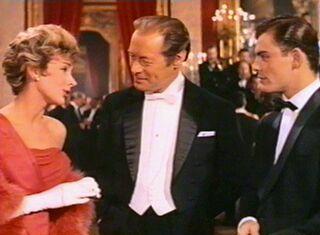
The Reluctant Debutante (1958)

Four Stars. I should dock it a star for the corny jokes and the dialogue and clunkiness of the timing, but I like the ending so much I'm giving it back.


Saw this one a while back and it's adorable. It's not quite the sixties but the same themes apply as in "Yours, Mine and Ours" and "Take Her, She's Mine" - the parents spend a lot of time shaking their heads in dismay at Kids These Days. But at least in this one the parents have their own conniving schemes - with the British Mum determined to get the most noble young man for her new step-daughter.

Sandra Dee in classic Sandra Dee fashion is crazy for a young drummer, despite being introduced to all the nice young society men at the parties of The Season in London she insists on dancing with a member of the band.

It's fun to see that the debutantes are direct descendants of the noble young ladies depicted in historical romance novels - only we're catching an imaginary version of the events as they faded into modern times. Rock'n'Roll was about to blow the waltz out of the water.

In a twist at the end the young drummer turns out to be more noble than the young gentlemen of the ball.

Rex Harrison is very funny as the overprotective father.

This is a favorite, will definitely watch again.