Showing posts with label 1930s. Show all posts

Saturday, August 13, 2011

Vivacious Lady (1938)

Some reasons I love this movie:
1. When Professor Peter Morgan (Jimmy Stewart) falls in love at first sight with night club singer/dancer Francey (Ginger Rogers), I believe it.
2. So many crazy scenarios are made possible by Peter's decision to wait before telling his very conservative university president father that he has married the unknown Francey during a trip to New York. Unfortunately, Peter doesn't manage to tell his family about Francey for a long long time.

3. Although Peter's cousin Keith shows early signs of wanting Francey for himself, when Peter and Francey are forced to spend their first night apart, Keith brings them each one of the toppers from their wedding cake to keep them company.

4. Ginger Rogers is tough. As Francey, she takes the woman who wants to be Peter's fiance and flips her right over her shoulder. She was provoked. A very funny scene.
5. The dance scene...
Three stars because the acting was great and the plot was really very funny. It think it lost that fourth star just for being a little too long. There were just a few too many crazy hijinks keeping the couple apart. Apparently TCM agrees. They called it "everlong." But I would definitely see this again.

Friday, August 12, 2011

It's a Wonderful World (1939)

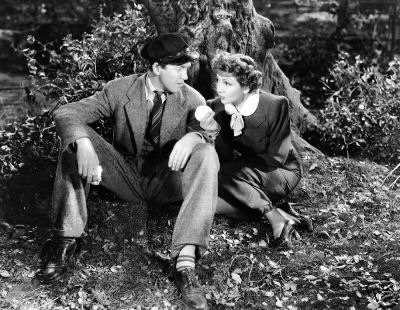
Turner Classic Movies is really a wonderful thing... So many movies not available on Netflix or from the library... Like this one with Jimmy Stewart. Stewart is detective Guy Johnson, arrested for hiding a client who has been framed for murder. While in a train en route to prison, Johnson notices a newspaper ad that may just be the clue he needs to lead him to the real killer. Johnson's dramatic escape from the train is witnessed by poetess Edwina Corday, played by Claudette Colbert. The rest of the movie is one crazy hijink after another.
There is the kidnapping of the poetess,
The handcuffing of the poetess to himself,
The poetess's realization that Johnson is not a dangerous escaped convict, but a noble detective trying to save his client from death row... a realization that leads to many misguided attempts to help him,
And a stolen disguise.
Apparently Claudette Colbert was unhappy with the bickering road trip similarities between this movie and It Happened One Night, but I didn't mind. Three stars just for reminding me that Jimmy Stewart can be good in laugh-out-loud comedy. I would be happy to see this again. "I swear by my eyes."

Thursday, August 4, 2011

My Man Godfrey (1936)

Eccentric rich people can be very funny. Especially if one of them is played by Carole Lombard, who is wonderful at appearing effortlessly nutty in a variety of situations. In this situation, Lombard plays Irene Bullock, one of two Bullock sisters in a family in which each member is insanely eccentric in their own special way. Irene is an expert at throwing fits, sobbing, fainting, and overdramatizing. She is very good at getting her way, even if it takes drawing out her fits over months. Irene's sister Cornelia is more sinisterly eccentric. She is good at making biting comments and scheming up ways to destroy the lives of others. Mrs. Bullock is just dotty. She sees pixies when she's hung over, and she keeps a protege named Carlo, who spends his days eating the family's food and pretending to practice his music. He also can do an intensely accurate gorilla impression to try to cheer up Irene when she's having a fit. Mr. Bullock, the apparent long-suffereing man in a family of loopy women, is only slightly less eccentric than the rest of his family. His eccentricity seems to be that he is incapable of keeping the rest of his family in check. Enter into this crazy family the dignified butler Godfrey (William Powell), and you have My Man Godfrey.
Of course even Godfrey has his eccentricities, though. Before becoming the butler for the Bullocks, he was a living in a New York City dump. How did he end up working for the Bullocks? He was picked up in a scavenger hunt. Mrs. Bullock earned points by finding a goat... Irene Bullock managed to get the catch of the evening, a "forgotten man." After Godfrey helps Irene win the scavenger hunt, she impulsively hires him as the family's new butler, and he enters their crazy home...

...Irene falls almost immediately in love: "Oh, you're more than a butler. You're the first protege I've ever had."

...Mr. Bullock loses all semblance of control over the family finances: "Why should the government get more money than your own flesh and blood?"

...Cornelia seethes over the fact that Godfrey did not help her in the scavenger hunt and plots revenge: "Godfrey knows I'm not being personal, but after all, none of us would like to wake up some morning stabbed to death."

...and Mrs. Bullock demonstrates her crazy thinking about the world: "[Godfrey's] the first thing [Irene's] shown any affection for since her Pomeranian died last summer."

Godfrey calmly goes with the flow, intervening only when Irene is a little too amorous:
G: "Hasn't anyone every told you about certain proprieties?"
I: "Oh you use such lovely big words. I like big words. What does it mean?"
G: "Well, I'll try to simplify it. Hasn't your mother ever explained to you that some things are proper and some things are not?"
I: "No she hasn't. She rambles on quite a bit, but then she never says anything.
I would watch this again. Three stars. One for Carole Lombard, who is always entertaining, one for making me laugh even when there were holes in the plot, and one for William Powell's Godfrey, who is keeping an eccentric secret of his own.

Monday, July 25, 2011

I'm No Angel (1933)

Well that was confusing... It is definitely a one star movie, but I just clapped at the ending. And not because it was over, but because I was laughing hysterically.

This movie raised a lot of questions for me:

Why was it not a bigger deal that when Tira (Mae West) was caught entertaining a rich man, her jealous co-worker showed up, hit the guy over the head, and the two of them left the man for dead in the hallway? It seems this was just a minor little mishap that created a need for Tira to make some more money.
"I think he's croaked."
"Where am I gonna put a stiff in this joint?"
"Put him out in the hall."

What did Tira's fortune teller think of her plan to make more money in the circus (she's in the circus!) by sticking her head in the lion's mouth during her lion act? She carries around an astrology booklet and seems to read it every morning, yet the new act seemed pretty impulsive.
"I'll even stick my head in the big cat's mouth!"
"Say, if them lions don't show some sense, I'm goin' down there and bite her myself."

Was Mae West really sticking her head in a lion's mouth? It sure looked like it. Where did the movie studio get all of those lions? And why can't I find a picture of them?

Why does Mae West include "Mmm-mm" at the end of almost everything she says? Character or actress? I suppose it goes well with phrases such as:
"When I was born with this face, it was the same as striking oil."
"Crazy for me, the guy's a pushover for me."
"I'll tell you this much. You're gonna like what I have in mind."
It also does go quite well with spritzing perfume all over one's self while singing, "No One Loves Me Like That Dallas Man..."

When on earth did Jack Clayton (Cary Grant) fall in love with Tira, and how did I miss it?
Jack arrived 49 minutes into the movie, and then 1 minute later they were talking marriage. The entirely unbelievable romance makes it impossible for me to give this movie more than one star, no matter how many ridiculous scenes made me laugh. The unbelievable romance and the cringe-inducing scenes with her black maids, that is.

Very important question: If David had been watching the final court scenes of the movie, in which Mae West saunters around the court room "Mmm-mm-ing" and cross-examining witnesses, would it have been more useful than the studying he was doing on his own for the bar?

And why did I not wear a crown at my wedding?

I will only see this movie again if Amy watches it with me. I'm not sure I would laugh as much seeing it a second time alone. Story and screenplay by Mae West.

Sunday, April 25, 2010

Flying Down to Rio (1933)

Ah, movies from the thirties. This is what I should be watching more of. Roger (Gene Raymond) is the conductor of a band and quite a player. When he spots Belinha (Delores Del Rio) winking at him from her table during a performance, it doesn't take him very long to leave the conducting to Fred (played by Fred Astaire) and sweep her up into his arms for a dance. News travels fast throughout the hotel. When the first comment, that Belinha, the niece of a wealthy Brazilian woman, is dancing with a musician, eventually reaches Belinha's aunt, the comment has run through the rumor mill and turned into "Belinha is dancing with a gigolo." The aunt rushes down to the dining room to put an end to the dance, and a romance/battle of words has begun. I was loving the movie... the first pairing of Fred Astaire and Ginger Rogers, funny banter, amazing hats...
I was so happy... until I got to the spanking and the racism, all of which happened within a span of about five minutes. I will explain:

The spanking: Belinha needs to get home to Brazil fast. Her father needs her. It just so happens that Roger is a pilot, and that he and the band already happen to be going to Rio to play at the opening of a new hotel there. Roger convinces Belinha to fly in his two person plane (although he at first doesn't tell her he is the pilot and disguises himself in his flying gear so her aunt will let her go with him). Belinha is perfectly happy to discover that Roger is the pilot, but when Roger has to make an emergency landing on what they believe to be a remote desert island, all turns sour between them. Roger makes his engine trouble last by purposely losing an essential hose. Then he plays romantic music to get Belinha to make out with him. And then... she says something along the lines of, "No no no...I cannot do this...My family has arranged a marriage for me...I am engaged...We must never see each other again." Roger doesn't take well to Belinha's protest, Belinha slaps him, and then he throws her over his knee and spanks her a whole bunch of times reprimanding her for telling him off. Needless to say, when they have to spend the night on the island, she stays far away from him.

The racism: The morning after the spanking, Belinha looks into the trees and sees four or five black men looking back at her. She runs into Roger's arms screaming about wild men and cannibals. When Roger goes back to investigate, he finds out that she was not seeing cannibals, she was just seeing resort employees. They are in Haiti right next to a golf resort. This was supposed to be a funny joke.

The rest of the movie did have more entertaining moments, though. The hotel happens to be owned by Belinha's father, Roger happens to be friends with the fiance, and Fred Astaire and Ginger Rogers dance, all while Roger and Belinha spar and can't take their eyes off of each other.
The best part of the movie was definitely when the band saves the hotel by creating the most spectacular opener ever: scantily clad girls dancing and doing acrobatics on the wings of planes in flight. At one point some of their clothes are even carried off by parachutes. At one point one girl almost plummets to her death and has to be caught by people on the plane below. Video below:
I also love the way in which Belinha's fiance finally gives her up...a parachute is involved. Two stars for silly acrobatics and fun. I could see myself watching this again, despite the horrifying parts.

Sunday, November 29, 2009

Kiss and Make Up (1934)

Oh no no no! Not a good Cary Grant movie!

Cary Grant plays the dashing Dr. Lamar of the famous Dr. Lamar's Temple of Beauty. Having given up his scientific ideals after medical school, Dr. Lamar is a cosmetic surgeon and beauty specialist who promises to help all women achieve "the pink and white complexion that is every woman's birthright." Should I mention that these words are spoken as we watch a black African woman and her two daughters sitting on the floor of their tropical home and rubbing Dr. Lamar's suggested face cream all over their faces?

Of course all of the women in Dr. Lamar's life are desperately in love with him, from patients to secretary Annie, played by Helen Mack. One woman who is in the office to inquire about a procedure for her mother even strips down to her slip when asked before admitting that she is not in fact a patient. Dr. Lamar's beauty ideals and the female "masterpieces" that he has created around him blind him to the beauty of "normal" women such as Annie. Annie can't be bothered to powder her nose, and she is actually capable of getting dressed in 15 minutes, "zippers permitting."

Dr. Lamar's real trouble begins when he falls for a married patient. Mrs. Caron has been visiting him for a very long time, much to the displeasure of Mr. Caron (Edward Everett Horton). Mr. Caron is horrified by the transformation his wife has undergone and threatens, "Doctor, put my wife back the way she was when I married her, or I'll take steps." Mr. Caron does not want his wife back the way she was because of his great love for her, though. He finds her to be too high maintenance now and is also adamant that a beautiful wife will be surrounded by lovers. "Do you realize what the husband of a woman like that is up against?" At first Dr. Lamar resists all of Mrs. Caron's advances (because of course the woman is trying to trap the poor innocent man).
"Are you so professional with all your patients?"
"No."
"Then why am I so...honored?"
But when Mr. Caron finally divorces his wife, Dr. Lamar very quickly marries her, "his masterpiece." For some reason Annie remains enamored with Dr. Lamar through all of this, even when he ditches her in his apartment, where she is taking dictation for his book, to run off to meet his gorgeous former patient Mrs. Caron.

Dr. Lamar and his new wife go off on their honeymoon, bringing Annie along so that she can continue to take dictation for the book. Of course Mr. Caron is also at the honeymoon resort celebrating his new freedom. Who does he fall for? Annie.
Possible best exchange of the movie, after Annie meets Mr. Caron while swimming...
Dr. Lamar: You allow men to pick you up in the water?
Annie: Why not? I weigh less there.

Of course Dr. Lamar realizes that he cannot make it to dinner on time with a wife who needs so much primping time. And of course he is horrified by the tasteless food she eats. And of course he is disgusted when he sees her in her face mask at night. I'm sure you can guess the ending of the movie. But do you know what funny animal is featured in the unnecessary high speed car chase leading to the end? Watch if you want to find out. (Or read the labels at the bottom of this post...)

One star. I may someday end up seeing it again, though, because of the fact that I own it in a box set. A previously unmentioned reason to maybe see this movie is that there are a few songs involved. Less of a draw is the ode to corn beef and cabbage sung by Annie and Mr. Caron. More of a draw is the song that Cary Grant sings twice about "Love Divided by Two."

Saturday, November 28, 2009

Thirty Day Princess (1934)

Oy. One star. My knitting project helped me to survive the movie. I'm not sure I could survive seeing this again, even though I own it.

What to say? A rich business man visiting the tiny country of Taronia befriends the king and learns that the country is much in need of money. He brings Princess Catterina (Sylvia Sydney) back with him to help interest Americans in the plight of Taronia so that they will buy bonds to fund improvements in the country. Sadly, Princess Catterina comes down with the mumps right after arriving. Is the money-raising scheme doomed to end before it has even begun? No! The business man has the brilliant idea to find a look-alike, a "thirty day princess" to play the part until the real princess can get back out of bed. Nancy Lane (also Sylvia Sydney, of course) is discovered in an automat stealing food. It turns out she is an out-of-work actress desperate for any job. Nancy's first job as the princess is to seduce the grumpy newspaper man Porter Madison III (Cary Grant), who has been publishing nasty articles about his theory that the Taronian bonds are a scam. What happens next is too easy...

Here it is, the moment when Porter Madison III falls in love with Nancy Lane (in her princess disguise):
He cannot resist her playful tossing of the expensive crystal wine glasses as she makes toast after toast to her ancestors.

After this, the country is in love with the fake princess, Porter Madison III is in love with the princess... all goes along swimmingly until the real princess's dolt of a fiance shows up. Two more men who have become convinced that the Taronian bonds are a scam discover that there is in fact a missing New Yorker who looks a whole lot like the princess, and who better than the princess's silly fiance to help them uncover what is really going on?

Will Porter Madison III still love the princess when she is no longer the princess? Will Taronia get its much needed money? I bet you know the answers.

Tuesday, November 24, 2009

Shall We Dance (1937)

This movie delivered all of the silliness that I have come to expect from a Ginger Rogers & Fred Astaire movie but oddly not all of the dancing. One of the "nearly" dance acts involved the two of them walking somewhat rhythmically back and forth on a ship.... But why did they not dance together more often?

"I haven't even met her... But I'd kinda like to marry her."
Petrov (Fred Astaire) is a ballet dancer (he can do anything!) who falls in love at first sight when he sees a flip book of the dancer Linda Keene (Ginger Rogers).

"What? You do not want to dance with the great Petrov? Don't be a silly horse!"
Petrov's first attempt to woo Linda involves pretending to a be a crazy man: dancing about her apartment, speaking in a heavy Russian accent, and telling her that she is not good enough to ever dance with him. It turns out that Linda is sick and tired of silly dancers falling in love with her. She is about to return to America to marry her long-time admirer Jim and get out of the dancing business. Petrov, his manager, and the whole ballet then set sail from Paris to America on the same ship as Linda. Petrov's manager shakes a former member of the ballet who is interested in Petrov by telling her that Petrov has been secretly married for four years. The rumor festers...

"Oh, you've ruined your sweater. I'll have to fix it now."
Petrov finally gets Linda to pay attention to him when he stalks her in the dog walking area of the ship. He starts paying other passengers to let him walk their dogs. Finally one day he has so many dogs with him that Linda's dog excitedly follows him. Soon Linda and Petrov are walking together daily. In fact, they walk so much that Linda's little dog gets tangled in his sweater and has to sit down and watch.


"Do you realize that you're the father of my child?"
A rumor that Petrov and Linda are married reaches the ship. Linda is horrified and thinks that Petrov has started the rumor just to escape another woman. When Petrov's manager is shocked to hear the rumor, Petrov points out that the manager in fact was the one who started it.

"Who's got the last laugh now?"
Linda charters a plane to take her off of the ship. She in her plane and Petrov on the ship eventually make it to New York. When Linda is forced to dance with Petrov in a restaurant where they are both dining separately she realizes just how much fun dancing with him is. Yay! A dance number!


"I'll turn that dream stuff into a nightmare that will make history. Poor Lin."
Linda's manager wants to keep alive the rumors that she is married to Petrov so that she will not marry Jim and leave dancing. He comes up with a brilliant scheme to use a very realistic dummy of Linda that had been designed for some old promotion. He sneaks into Petrov's room at night, drapes the Linda model over him, and takes some new pictures for the press. Luckily, Petrov is such a heavy sleeper that he is not woken up by the flash bulbs.

"You like potatoes and I like potahtoes..."
In order to evade reporters, Petrov and Linda put on dark sunglasses and go rowing and roller skating in Central Park. This leads to song and roller skate dancing. A very good way to prove that you are in fact not a couple.


"Peter, you've got to marry me... If we can get married now, I can start divorce proceedings in the morning."
Again, another brilliant plan. Get married, so you can officially get divorced, thereby proving that you are not in fact married.

"I didn't realize getting married was so depressing."
After Linda puts on an amazing hat and marries Petrov, she begins to realize that she doesn't really want to divorce Petrov the next day. Until the original trouble-making lady appears in Petrov's room.

"All because of you and your practical dummy!"
Everything is a mess! Will Linda go through with the divorce? Will Petrov win her back with his crazy scheme to dance with dozens of women all wearing incredibly creepy Linda Keene masks? What will happen?

"If he couldn't dance with you, he'd dance with images of you!"
Awwww. And so on... I guess just two stars, as sad as that sounds, and I probably won't see this again. The Gay Divorcee is definitely my favorite so far.

Tuesday, October 13, 2009

The Wedding Present (1936)

So, Richard Wallace creates a film in which Cary Grant and Joan Bennett are witty newspaper reporters in love who just can't seem to end up together. Then four years later Howard Hawks makes a film in which Cary Grant and Rosalind Russell are two witty, divorced-from-each-other newspaper reporters who just can't seem to end up back together. Hmmm. Very popular theme of the time?

In this one, Charlie (Cary Grant) and Rusty (Joan Bennett) work on the paper together and are "almost married." After a botched attempt to get a marriage license, Rusty declares that it was silly of them to try, and they should just stay in their happy "almost married" state. Not even a night spent carousing with a silly archduke, about whom they want to write a story, can convince Rusty that really they should just break down and try to get married again. Not even when the archduke tells them, "Oh, but [marriage] is a divine madness."

So on they go with their lives as flirting reporters until Rusty is granted a month's vacation. While she is in New York trying to make Charlie jealous, Charlie gets a surprise promotion to editor. Rusty returns to find him no longer his old fun-loving self. She thinks up a giant prank to help him get his sense of humor back, but ends up getting herself fired.

Rusty meets a new man on her way to New York to find a new job and soon finds herself engaged. What will Charlie do? Why, travel to New York to give her the best wedding present ever (involving fire trucks, ambulances, police sirens...).

No, the wedding movies are not my new theme (did you notice I watched Night of the Living Dead?), but maybe I can gleam some tips from all of these wedding-related movies... In any case, I would see this again (and probably will since David got me a box set that contains it). Probably just two stars from me, though: Fun and silly, but also dopey and silly if I'm thinking seriously about it, and it's definitely not as brilliant as its witty newspaper movie rival.

Saturday, June 20, 2009

The Gay Divorcee (1934)

Ohh, wonderful wonderful silly movie.
Guy meets girl...
Mimi (Rogers) gets the end of her dress stuck in her aunt's trunk as her aunt locks it. Guy (Astaire) comes by and saves her by quite shockingly ripping her dress. He is smitten. She runs away. He spends weeks in London standing on the sidewalks and starting at every woman's face to find her until he finally rear-ends her car by accident.
Girl runs from guy...
Every silly dance movie needs a high speed car chase.
Guy pursues girl...
Lucky thing that Guy thought to buy a "Road Closed" sign at a sporting goods store. What a good way to bring a high speed car chase with one's beloved to a halt.
Girl starts to fall in love...
After losing Mimi again, Guy happens to find her at an ocean resort. She is there to try to secure a divorce from the geologist husband she hasn't seen for years. He is there with his lawyer friend who is helping Mimi to secure the divorce. But of course Guy does not know Mimi is the woman his friend is helping. Guy is charming and sweeps Mimi off her feet.
Girl becomes convinced guy is a gigolo (rather, a correspondent)...
The plan that Mimi's lawyer has concocted to secure her divorce involves her spending the night with a hired male "correspondent" and then getting caught by some detectives. Guy unknowingly says the code phrase to Mimi that the correspondent is supposed to use to find her, and Mimi is furious that Guy is not really interested in her but is there for a job. One of many many similar jobs.
Everyone dances...
They even twirl up onto chairs and over tables.
Happy ending...
Dancing solves all problems, of course!
I hope I get to see this again. It's now my favorite Ginger Rogers & Fred Astaire movie. Four stars!

Saturday, October 27, 2007

Another Thin Man (1939)

Asta does tricks! I had to rewind a few times to watch. He gets so excited that he does a full backflip. The backflip alone earns this movie at least four stars. Plus, one of my little first graders had just written a story about her dog Canada who she claims can do a flip, so I got to tell my student I watched a movie that made me think of her story. So Asta's backflip made a first grader very happy, too. And now, as the owner of a Thin Man box set, I can watch this movie as many times as I want. Will I ever review a movie I don't like?


Anyways, this Thin Man movie finds Nick and Nora with a baby, Nick Jr. So of course baby humor becomes an important part of the plot, mixed in with the new murders. Imagine all the cute and zany things one can do with a movie baby, especially when the baby's father knows a lot of crooks. Some of Nick's crook friends even throw a baby party for the Charles family...hilarity ensues (am I allowed to use that phrase, too?)

Mostly, ignoring the plots of the different movies, I just continue to love Nick and Nora and their witty dialogue.

I'm left wondering a few things, though, after this movie: As the series goes on, will the movies really remain good? (Although, Amy, you seem to have seen the later ones and liked them...so maybe I shouldn't be worried.) Will Nick Jr. help solve any crimes? Will Nick Jr. and Asta have to take up drinking? And, do all the Thin Man movies need a scene in which all of the characters are forced to get together so that Nick can work his brilliance in front of them all? I need to keep watching and find out.

Sunday, October 14, 2007

After The Thin Man (1936)

Many many stars...will watch it many more times along with the first movie...am buying the Thin Man box set!

Ever since rewatching the first Thin Man movie this summer, I have been so excited to see more of the series. I was not disappointed. After the Thin Man picks up right where the first movie left off with Nick and Nora on a train to San Francisco. As they prepare to pull into the station Nora asks, "Are you packing?" to which Nick responds, "Yes, dear, I'm putting away this liquor."

They arrive home ready to sleep for a week and recover from their detective work in New York, only to be dropped right into the middle of a new mystery. Nora's cousin's husband has been missing for three days... Is he dead? Is he with another woman? What does young Jimmy Stewart have to do with all of this? Does Nora ever get her middle-of-the-night scrambled eggs? Asta even gets his own storyline in this movie involving Mrs. Asta and a lot of puppies.


I laughed through the whole movie. Now I just have to wait for Another Thin Man to arrive from the library...

Tuesday, August 21, 2007

The Women (1939)

Four Stars. Will watch again forever!


Norma Shearer plays a wealthy New York woman who learns that her husband is cheating on her from a gossipy manicurist. Her gossip-loving friend Syliva is played by Rosalind Russell who also stars in "His Girl Friday".

There are so many things to love about this movie. Starting with the opening credits where each character is introduced as an animal first, and then converted to a woman:
Norma Shearer as the Doe ~ Mrs. Stephen Haines (Mary)
Joan Crawford as the Leopard ~ Crystal Allen
Rosalind Russell as the Cat ~ Mrs. Howard Fowler (Sylvia)
Mary Boland as the Monkey ~ The Countess DeLave (Flora)
Paulette Goddard as the Fox ~ Miriam Aarons
Joan Fontaine as the Lamb ~ Mrs. John Day (Peggy)
Lucile Watson as the Owl ~ Mrs. Morehead
Phyllis Povah as the Cow ~ Mrs. Phelps Potter (Edith)
Virginia Weidler as the Fawn ~ Little Mary
Marjorie Main as the Horse ~ Lucy

Virginia Weidler is Dinah in the Philadelphia Story making her the strange precocious young girl in two of my favorite movies.

The movie is also deliciously self-conscious. "I know plenty I wouldn't breathe about my friends' husbands," says one woman, "oh, so do I!" responds another - they both stop talking for a moment and the thought is so clear it doesn't need to be said - what might my friends know about me? A minute later the subject of the juicy gossip, Mary, leaves the room singing "please don't talk about me when I'm gone..." fat chance, Mary.

The funny thing about the movie is it celebrates the epitome of cattiness without letting it triumph in the end...although sexism and classism come out on top. The rich and virtuous triumph over the poor and slutty and the men are proven to be the victims and the women the instigators of all the evils of divorce and adultery. The [Evils of] Women could be the unofficial title of this film.

One of the central morals of the story is that the woman whose husband is cheating on her should stick loyally by his side and say nothing. A man is a man and adultery is just what comes with the territory. She should wait for him to come to his senses (it's okay to wait in Bermuda, for example) - but she most certainly shouldn't let her girlfriends talk her into divorcing him.

"Don't confide in your friends. They'll see to it in the name of friendship that you lose your husband and your home."

So instead the woman in question decides to fight the "other woman" (OW) - not the cheating man. This is in direct contradiction to what Oprah tells us to do! Eventually she caves to the advice of the crowd and finds herself divorced and - naturally - miserable. What's a woman without her man?

There are echoes of The Awful Truth, here - you can leave your spouse, but you will eventually regret it!

Not surprisingly, in the movie we learn conclusively that the man in question is hapless and a little helpless and was lured into the arms of a cunning and conniving woman a "terrible man trap". It's hard not to get enraged while at the same time being amused watching Joan Crawford curl an imaginary man on the telephone around her little finger.

Of course, in real life, ninety-nine times out of a hundred "the other woman" is the hapless-helpless one and the man is cunning and conniving. Or the OW is hapless and desperate and the man is helpless and lying. Or all three parties are hapless, desperate and miserable. Watch Jerry Springer if you need a case in point.

However you slice it, I wouldn't say this movie contains a lesson to be absorbed too deeply. What it can teach you is how to converse with queens. Try these lines for instant success at gay tupperware parties:
About red nails: "Jungle red - looks as if you've been tearing at somebody's throat."
About bread: "Go ahead, dear no starch it's gluten."
About hand towels: "Cheap chinese embroidery - I bet Peggy gave these to her."
About the man trap: "She's got those eyes that run up and down a man like a searchlight."
About adulterous husbands: "Say nothing, and don't forget that's my handkerchief."
About children: "I'm all the baby he wants, toots!"

You'll want to keep your remote handy for this one - and if you don't have Tivo, rent it - there is no possible way a human being could catch all the catty one-liners without rewind or instant replay. And if you love catty one-liners as much as we women do, you will love this movie.

Thursday, August 16, 2007

Big Brown Eyes (1936)

My *current favorite* - four stars!
Will definitely watch again!

This may be the only romantic comedy I've ever seen in which a baby is shot. Yes, the baby is shot by the villain's henchman, and yes, the happy couple spends the rest of the movie tracking him down and bringing him to justice. But still, you have to imagine how today's studio executive would have treated this script. I imagine the meeting in his office the day after he reads the script.
"In act two, a baby is shot?"
"It drives the plot!"
"A baby! Gets shot!"
"But it gives the story a moral depth..."
"Moral Schmoral, why can't we kill a bum - or a really fat guy? Nobody minds seeing an ugly person get shot!"
"But you see then it wouldn't be something the reporter could sensationalize!"
"You can sensationalize a bum!"
"How do you sensationalize a bum? A bum's not sentimental!"
"You're the writer, that's your job! You can make a bum sentimental if I tell you to!"

But I digress. This is my new favorite movie so I must tell you why! Cary Grant impersonates a woman flirting with himself (he's an amateur ventriloquist). Manicurists wear uniforms with little bows on them. The dialogue is faster than a machine gun. The women are smart and sassy and the men are big lugs who do their bidding without being aware of how easily they are played.

Can you see how all this adds up to a movie in which a baby being shot seems kind of irrelevant?

Benny: And me as honest as the day is long.
Eve: Yeah, but how 'bout the nights?
Benny: The nights too! I'm the soul of honesty.
Eve: You sure you don't mean 'the heel?'

Saturday, July 21, 2007

The Awful Truth (1937)

Cary Grant wishlist again! I've seen this one so I only watched half of it and then Jess and I fast-forwarded through the end to remind ourselves how it ended. She remembered the weird cuckoo-clock and the door that factors into the happy reunion of the couple.


Basically, this is one of those movies where a married couple starts the movie off with a hasty divorce and we wait for them to get reunited (and remarried) at the end.

Cary Grant also does this in The Philadelphia Story, doesn't he? He's often divorced. In House Boat, too, he's about to get a divorce when his wife dies.

Anyhow, they are supposedly sharing custody of the dog, who is played by Asta again! In the movie his name is Mr. Smith.

I have to say, though, I love Irene Dunne's outfits, even her cooky hats are kind of entertaining more than annoying, but I HATE her hair.

I feel too sorry for the characters (especially Ralph Bellamy's Oklahoma Oilman) to give it more than three stars, but it's a great romantic comedy.

Will definitely watch again, sometime.
Three stars.

Sunday, July 8, 2007

Topper (1937)

My Tivo's Cary Grant wish list picked this up. I sat right down to watch because it's a comedy and involves ghosts and Cary Grant - a really young CG.


First off CG looks great in this movie and it features special effects that I really have no idea how they achieved in that era. I really would like to know. They also had a really interesting rectangular-shape wipe transition early on in the film that must have been quite a feat at the time. Mainly, the ghosts disappear and reappear right on camera about four or five times which probably was a really big deal at the time. The equivalent of Transformers, probably.

CG and Constance Bennet play a dashing young couple - kind of an F. Scott Fitzgerald and Zelda at the height of their partying. They die in a fantasitc car wreck - you spend the first thirty minutes waiting for them to die in a car wreck cause you know that they will die and cause they drive everywhere like maniacs in this crazy cool car with a really weird fin on the back that I imagine was the 1930s equivalent of a DeLorean.

Anyway, after death they try to do a good deed by loosening up their stiff banker friend - Topper - who seems like he's not having any fun with his life and antics ensue.

The antics are alternately funny and not - hard to tell which gags might have been fresh at the time but are really old hat now. Like the invisible ghosts moving things causes all kinds of people to make surprised faces and rub their eyes - but in the days before Bewitched and I Dream of Jeannie that might have been a laugh riot - who knows?

I like/hate the character played by Billie Burke - the prim proper and puritan patrician wife of the banker who just wants to be invited to a party by the Stuyvesants. But my FAVORITE character is the irritated butler who gets in the middle of the feuding husband and wife.

Cary Grant is really handsome and Constance Bennet is awesome as the playful, flirtatious, sexy but still totally good-hearted and somewhat innocent girl - the epitomy of who we all think we would have liked to have been in the 30s. She also has great hair and great outfits and gets to appear suddenly atop a ledge in a new outfit holding a bottle of champagne and get the better of a rude bellboy all in the same act and don't we all want to do that someday?

Three Stars. Would watch again.

A Bill of Divorcement (1932)


My Tivo picked this up for me under my Katharine Hepburn wishlist (I have three wishlists: for KH, Cary Grant and Sandra Dee) on TCM. It's a drama, which normally I don't like (prefer, in this order: romantic comedy, comedy, musical, western - I generally skip horror and drama).


In fact, I was set to watch Little Women, which I've seen before and don't like that much (because I always think Jo should end up with Laurie but that's another post). However, in the introduction to Little Women Robert Osbourne (the TCM host and my TV movie buddy) said that A Bill of Divorcement was KH's first movie, so I thought I ought to at least give it a chance.

Katharine Hepburn plays a young woman whose father is in a mental institution and has been for as long as she can remember. She is recently engaged and very much in love. Her mother has divorced the mental patient and is about to remarry a guy who can buy her a mink (which is supposed to be proof that he's the one who can really make her happy) when suddenly the father arrives at the house.

This is the point where you know it's based on a play because the only setting they ever appear in is this house. There might be several rooms, I'm not really sure because I was baking pies, but it's all in the house. The father has "come to his senses" all of a sudden and walked right out of the mental institution and home - this is strange because he doesn't recognize the house and makes some reference to how it's bigger than the old place - meaning presumably this is a house he's never been to before.

Anyhow, the mother gets married but can't bear to tell the father the truth and KH is caught in the middle of the drama trying to protect both parents. She's supposed to be somewhat temperamental and prone to outbursts - inclined towards insanity, we assume. So right away she takes her father's side, but she still sympathizes with her mother.

In the end, she breaks off her engagement because she's afraid of having crazy babies and sacrifices herself to live with her father so her mother can go, guilt-free, to live with the mink-buying man of her dreams. The ending is really unsatisfactory and strange - it just kind of trails off with a father-daughter piano-playing scene.

At first I was just completely struck by how KH was made up in the 20s style. Her mouth is dark and precise and her face pale and her eyes very dramatic and dark and pointy with slender eyebrows.
This plays her up in a such a different way than in her later movies when she was all mouth and cheekbones and eyebrows with very natural eyes. I was totally fascinated with this for the whole first act.

The whole movie was melodramatic in the extreme and I was left with mixed feelings about the way mental illness was portrayed. (My dad's a psychotherapist and I have several mentally ill family members so I'm fairly sensitive to portrayals of "crazy" people in movies).

The mentally ill father is played by John Barrymore (grandpa of Drew) melodramatically as a weepy, sentimental mess with a temper. Since all the characters are over-played that wasn't really troubling - almost every character was an offensive stereotype so, really, this guy gets fair treatment.

There were two theories advanced in the movie: that the mentally ill father was inherently insane because it was "in his blood" and that he came home from the war with shell-shock. JB makes a great speech about fighting to protect people who then marry other people and all he got was shell-shock - that will make the top ten list of guilt-trip monologues, for sure.

It's not that different from today, really - the causes of mental illness are still linked to both trauma and genetics. But the idea that you would not marry because you couldn't have children (no way!) and not have children because they might possibly have mental illness (huh?) seem completely dated.

Also, since these days we wouldn't put the guy away for what seems like a mild case of depression or PTSD, she'd never have got the Bill of Divorcement in the first place, and the whole movie would be blown.

Would NOT watch again. Definitely wouldn't have finished if I wasn't baking pie.

Two stars.