Showing posts with label marriage. Show all posts

Wednesday, March 23, 2011

The Philadelphia Story (1940)

"Oh Dexter, I'll be yar now... I promise I'll be yar." And with statement, the independent, smart, and funny Tracy Lord (played by Katherine Hepburn) gives in to her ex-husband (Cary Grant) and admits that women should be sweet and manageable and that she has been wrong to be so strong in the past. Warning: Although I do love some things about this movie, I'm not feeling very generous toward it at the moment. I forgot between viewings just how many painfully obnoxious moments there are.

The movie begins with Tracy preparing for her marriage to a second husband. The first marriage, we learn, ended because of Dex's (Grant's) drinking problem. A paper wants to do a story on the wedding (Tracy is high society), but Tracy is too private to allow photos. The paper's head honcho happens to have a story on Tracy's dad, who happens to be having an affair. He blackmails Dex into bringing a reporter and a photographer into Tracy's family home, promising to sit on the story on Mr. Lord as long as there's a story on the wedding. James Stewart plays the wonderfully sarcastic reporter who falls for Tracy. Much hilarity ensues, involving swimming, champagne, crooning, and huge hangovers.
My problem with the plot, is that we are later shown that Dex's drinking wasn't really the worst of things in Dex and Tracy's marriage. The worst of things was that Tracy was a "distant goddess," unable to accept frailty in others or to offer womanly warmth and support. First Dex tells Tracy this. Then James Stewart makes some statements confirming it...only he doesn't mind. He's new enough to like putting her up on a pedestal as a "queen." Then... final straw... Tracy's somewhat-estranged father returns from his affair with a young dancer in NYC and essentially blames Tracy for the fact that he had an affair.

And here it is, the most annoying part of the movie:
Mr. Lord: What most wives fail to realize is that their husband's philandering has nothing whatsoever to do with them.
Tracy: Oh? Then what has it to do with?
Mr. Lord: A reluctance to grow old, I think. I suppose the best mainstay a man can have as he gets along in years is a daughter - the right kind of daughter.

And then he goes on to explain. You see, Mr. Lord just needed a way to hold on to some of his youth, but instead of being blessed with a sweet young daughter to help him, he ended up with a harsh, shall we say "shrew," of a daughter who had a "prejudice against weakness." Seems she didn't like putting up with a constantly drunk husband or a dad who was off very publicly cheating on her mom.

Another way of looking at this movie is that it is in the "divorced, but will they find their way back together?" category of films. Cary Grant seems to be in a bunch of these. I believe the lesson in this film is that if you let yourself be tamed, yes, you can have a second chance. Despite my rants, I'm still giving this three stars, because the acting was fantastic, and I'm willing to put some blame on the time period in which it was made. And Dex does at least tell Tracy, "Be whatever you like, you're my redhead," and he has given up his drinking when he returns. Anyways, I know I'll see this and rant and laugh many more times.

P.S. - Something enjoyable that does not come with a rant:
With 12 movies on this blog already tagged with "odd precocious little girl," I can't believe one of them was not this movie. Virginia Weidler, as usual, plays the perfect "odd precocious little girl," from her early comment about the papers being "full of innundo" to her dramatic interpretation of a spoiled little rich girl, when she and Tracy try to mess with the reporters sent to do the story on Tracy's wedding.
And of course there's her comment about the fancy dress she wears to the wedding...
Mrs. Lord: I think that dress hikes up a little behind.
Dinah: No... I do.
I am a huge fan of Virginia Weidler.


Wednesday, September 22, 2010

Mr. & Mrs. Smith (1941)

A Hitchcock slapstick comedy... fascinating. Hitchcock's only comedy... I can kind of see why. Having said that, the movie wasn't un-funny, it just didn't live up to my slapstick expectations. It kept falling short. Carole Lombard is fantastic with slapstick (Nothing Sacred), but there wasn't enough for her to do here.

When we meet Mr. and Mrs. Smith (Carole Lombard and Robert Montgomery) they are holed up in their bedroom. One of the rules of their marriage is, "You are not allowed to leave the bedroom after a quarrel unless you've made up," and they had a fight two days ago. While the help watches for them to emerge and Mr. Smith's law firm panics over his absence, Mr. and Mrs. Smith finally reconcile, agreeing that their rules for marriage have once again helped them to trust and love each other. Before Mr. Smith leaves for work, though, Mrs. Smith reminds them of their "no lying" rule, and asks Mr. Smith to honestly tell her whether he would marry her all over again. Mr. Smith very naively answers that although he loves her, if he had it to do all over again, he would hold onto the single life. Oops.

Upon arriving at work, Mr. Smith is then visited by a lawyer come to tell him that, guess what, his marriage license isn't valid. It turns out all people who got married in 1937 in Nevada with an Idaho license are not really married and that "it'd be better if everybody kind of got married again...to be on the safe side." Oops again. Mr. Smith is kind of excited about the idea of dating his wife again and doesn't seem to plan to tell her right away. The lawyer happens to be a family friend of his wife, though, and stops by to see her next. Mrs. Smith's mother is horrified, demanding that her daughter not spend another night with her husband until things are righted. Mrs. Smith is convinced that, despite the morning conversation, of course her "husband" will whisk her off to City Hall that very night after dinner. Otherwise: scandal.
But, the dinner doesn't live up to expectations, and there is no proposal. Instead, Mr. Smith tries to lure his "wife" into the bedroom. Horror! Mrs. Smith tells him what she knows and accuses him of having tried to use her "and then throw me away like a squeezed lemon." Mr. Smith is banished to a room at the men's club, and Mrs. Smith decides that maybe she would like to date other men. Mr. Smith spends the rest of the movie trying to win his wife back. At one point he even tells her, "From now on we're just friends." Her response:"Not necessary."

The favorite scene for both me and David involved Mr. Smith pretending to be deep in conversation with a pretty lady seated near him in a restaurant. Not only is his wife not jealous, but the pretty lady eventually turns around and notices the creep pretending to whisper in her ear. The scene below was pretty funny, too:
So all in all, only two stars, but I would probably watch this again, and I think all Hitchcock fans should be aware of his venture into slapstick.

Saturday, July 24, 2010

Follow the Fleet (1936)

Oh, I hope I never run out of Fred Astaire & Ginger Rogers movies. In this movie they play Bake and Sherry. Bake is in the Navy, Sherry is a dancer who once rejected Bake's marriage proposal. When Bake comes into town on shore leave, he runs into Sherry, and they both rethink their separation. Bake messes up Sherry's very important audition, though, and all bets are off. How do you say sorry? Give someone a monkey and screw with their next big audition, not necessarily in that order.
There was also a bizarre side-story involving Bake's friend Bilge, played by Randolph Scott. After having one great date with Sherry's sister Connie, he felt that he was still free to play the field, and she felt that they had made an amazing connection and were getting married. Bilge's thoughts on Connie's thoughts? "She's a swell kid, but she's serious... She's sappy like you [Bake] - she wants to get married." And oddly none of Connie's friends told her that she was being a bit silly fixing up her father's giant boat just for Bilge and waiting for his proposal after just one date. There wasn't even any word from him while he was back at sea, and still she waited. She was told oh, he's just being silly... He'll figure it all out in time. She is told to fight for her man. But she practically imagined him! Nonetheless... do you think she got him in the end?
While watching the movie, my dad was busy looking up information about it. Apparently the dress worn by Ginger Rogers when she and Fred Astaire danced to "Let's Face the Music and Dance" (above) was so heavily weighted that she had to learn how to move while wearing it. And apparently she bonked Fred Astaire in the face. It was weighted so it could then effortlessly do things like this:
...which is of course a very important part of a Ginger Rogers & Fred Astaire movie.

Despite my love of the actors, I really want to give this movie one star. But I'm going to give it two stars due to the scene where they navy guys are all practicing for a benefit show on the ship deck, and some of the men have to be "dames." I really don't want to see it again, though. There were entertaining moments, but I think the whole buzz behind this movie is that it has what is considered to be one of Astaire and Rogers's best dance numbers (with the 25 pound dress). But that was not enough for me. I still love them in general, though!

Friday, May 21, 2010

The Seven Year Itch (1955)

I won't be seeing this movie again. I can say I've seen the famous blowing dress scene and move on.
Richard Sherman's wife and son, along with all the wives and children of the New York businessmen, have left the city for the summer. So what are all the husbands to do? "Drinking, smoking, picking up girls, playing chopsticks..."
Richard Sherman wastes no time in getting to all of this, but it's okay, because he's been married for seven years, and it is a well-known fact that men experience a seven year itch and need to branch out a bit. And anyways, he just spends most of his time thinking about cheating and running around being sneaky... So no worries. Despite Richard's assertion that "no pretty girl wants me. She wants Gregory Peck," he quickly picks up his new upstairs neighbor Marilyn Monroe, known as "The Girl." Does she even have a name? She's ditzy, she wears sexy dresses, and she's willing to kiss him just for fun, because he's married and she doesn't have to worry about him proposing or anything. Richard narrates the whole movie. We hear his every thought. And I don't find him likeable. So can I give the movie zero stars?

Yes, I would have preferred:

Friday, April 23, 2010

Easy to Wed (1946)


I can only hope that on the day of my wedding David and I get to perform a long song and dance number for all of our guests. In fabulous technicolor costumes.

This movie is Libeled Lady in color... Or so I think. I got this movie because it was a recommended Esther Williams movie and found out upon reading the DVD sleeve that it is in fact a re-make of Libeled Lady. After watching the trailer for Libeled Lady and reading Amy's blog post, I think it is pretty safe to say that Easy to Wed is just a remake in color...mostly the same dialogue, with a few changes: Lucille Ball for Rita Hayworth, duck hunting for angling, swimming stunts for no swimming stunts... The older movie does have William Powell and Myrna Loy, though, so I am ready to believe that it was a better movie. Now of course I very much need to see Libeled Lady to compare.
The movie starts with a slander suit. Connie Allenbury (Esther Williams) and her wealthy father are suing a newspaper for two million dollars for publishing an article that called Connie a husband stealer. Warren Haggerty comes up with a brilliant plan to save the paper... hire back Bill Chandler (Van Johnson), a reporter he had long ago fired and a man just sleazy enough to be willing to trick Connie Allenbury into actually stealing a husband, thus ruining her lawsuit. For Connie to actually steal a husband, though, Bill needs to be a husband. Haggerty gets his fiance, Gladys (Lucille Ball) to marry Bill so that Gladys can then discover Bill cheating on her with Connie.

Bill goes to great lengths to win the trust of Connie and her father. He even pretends to be an expert duck hunter, a lie which gets him invited for a weekend of hunting at the Allenbury cabin. While he's at the cabin, he realizes that Connie isn't actually the spoiled brat she appeared to be. She just comes across that way to protect herself after years of being harassed by men who want her for her money.
Once Connie trusts Bill, she drops her stuck-up act and...
Now Bill has a problem, though. He is actually in love with Connie and no longer wants to go through with the plan. Much hilarity ensues. Some of it involves Bill and Gladys pretending to be ducks to learn the art of duck hunting. (Long video, but fun!)

So three stars, because it really was a funny movie. One of those stars is for a scene near the beginning of the movie when Esther Williams water skis down a giant slide standing not on water skis, but on a man's back. I'm not sure I'll see it again, though. I will see Libeled Lady.

Sunday, November 22, 2009

How to Marry a Millionaire (1953)

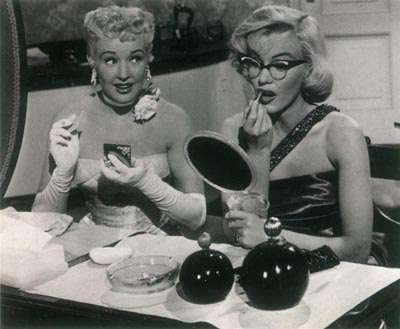
So, here is my very naive question: Is there a movie in which Marilyn Monroe does not play a ditz? Yes, yes, I'm supposed to know things like this. I just haven't seen very many of her movies. Only Some Like It Hot and Bus Stop (Amy, do you remember Bus Stop?). Oh, and that little moment of a part in All About Eve. This time, Marilyn plays a ditz with glasses who has to take her glasses off any time there is a chance of being seen by men. "You know what they say about girls who wear glasses." Sadly, this causes her to bump into things frequently and get even more confused than she is with the glasses on.

Three models, Schatze (Lauren Bacall), Pola (Monroe), and Loco (Betty Grable) move into a luxury condo in order to meet and catch millionaires to marry. Unfortunately for them, the rent is much too steep and they are forced to keep pawning their rented furniture. Schatze, having been married and cheated before, is adamant that the girls not waste any time on men without a fortune. Men like the ones Loco keeps bringing home.

One of Loco's unacceptable finds, Tom Brookman, falls for Schatze, but she only has eyes for the rich Texan widower J.D. Hanley (William Powell). Little does Schatze know that Brookman is in fact a millionaire. But while Brookman goes to great lengths to court Schatze (even booking the three girls to model clothes for him in a store!), he is careful not to let Schatze know about his wealth lest she pick him based on that. While Schatze chases after Hanley, who is afraid that she would be wasting her life to marry an old man, her friends go off and find the loves of their lives: men with no money! I will not give away the hilarious circumstances under which they find their loves. Her friends' happiness eventually causes Schatze to re-think her obsession with rich men, with terrible timing for the poor Mr. Hanley.

Three stars, and I would definitely see this again. Now, if I only I could write a new ending for William Powell's character.

Tuesday, August 5, 2008

Libeled Lady (1936)

Jean Harlow is my new favorite actress. She is the original blonde bombshell. I suppose that Marilyn Munroe did have more vulnerability, but I like Harlow for being the tough broad that she is, always a step ahead of the man, ready to head him off at the pass.

In real life she and William Powell were lovers and went to the Academy Awards together along with Clark Gable and Carole Lombard who was Powell's ex. It all sounds very free and 30s Hollywood.
I love Powell and Myrna Loy, so it's fun to find out who he personally was drawn to and see him play opposite her and Myrna in the same movie. In this movie he's the charming ex-newspaper man who is hired to seduce the heiress who is suing a newspaper for a false story.


In order to make his affair with ML a scandal, he has to be married to JH. It's quite entertaining, and I still don't know how it ends, which is good, but I'm really getting aggravated with Powell.


...

Okay, I finished watching - it was one of those comedies that keep you aggravated till the last second when of course it all works out. I know some people find those the best, but I felt aggravated on behalf of Spencer Tracy's character and Jean Harlow's character even AFTER they were all living happily ever after.

Well worth watching, some very fun, funny moments, but can't give it more than two stars and I WON'T watch it again.

It's also interesting to note that William Powell plays the same calm, wry, somewhat smug character out-witting everyone to his own advantage in these movies that he does in the Thin Man, but it's so much less sympathetic when he's outwitting people who you actually can care about like ST and JH's characters here.

Thursday, July 31, 2008

The Marrying Kind (1952)

Q: What's not to love about Judy Holliday?
A: Nothing!
She's the best part of this picture, I'd say, and she gets to play a lighthearted but not lightheaded blonde. She's not too ambitious for herself, but she believes in things like her husband's crazy invention and radio contests and bright possibilities for her future.

Judy Holliday and Aldo Ray portray a couple who are divorcing. The story of their marriage told in flashbacks is comic and dramatic in turns and probably plays better with a married audience.
The voice over cleverly does not always match the story as the audience can see it so we're lead to understand how both husband and wife are distorting their side of the story as they are telling it to the judge.
It's reminiscent of the Crowd if anyone has seen that silent film - the young couple living the American dream in the city, trying to make ends meet, having a family, eventually encountering hardship.

Through it all there are glimmers of the couple being something a little bit better than they think they can be - enough to make you believe the judge's conclusion that they will not get a divorce after all.
Of course, she's right, they make up and stay together. It IS a romantic comedy after all.
Not a first date movie, though. One to rent to watch with your spouse during a difficult year.

Sunday, June 1, 2008

Forsaking All Others (1934)

I have a confession to make: I mostly watch classic movies because I am so often disappointed by the lack of new movies that suit my taste. I seem to like a kind of movie that's no longer being made: witty, clever, fashionable, romantic, funny and with a good, believable happy ending. I faithfully trudge to the video store to pick up the latest releases (I'm too cheap to see them in the theater) and I'm constantly disappointed by the "Along Came Polly" and the "Failure to Launch" of this world. I find some small comfort in a movie like "Two Weeks' Notice" or "50 First Dates" which have a passable combination of humor and romance. But where is the wit? The costumes? The happy ending that doesn't seem glued on but results from the intrinsic natures of the characters themselves? I basically live for Jane Austen novels to be made and re-made as movies...and therefore I must go backward, into the archives, for my "new" movies.


That's why, when I discover a movie like "Forsaking All Others" I feel a sense of triumph equal to an archaeologist stumbling on a Mayan temple - I didn't create it - I didn't exactly "discover" it - I mean, it was there all along - but I have unearthed it again - brought it to light - and now I can share it. These are the moments I live for!

In Forsaking all others you have a classic, perfect love triangle. Mary, Jeff and Dill grew up together and for as long as they can remember, Mary has loved Dill and Jeff has loved Mary - only of course Mary doesn't know that Jeff loves her - and Dill seems to love Mary. Of course, Jeff has gone off to Spain to make his fortune so he can propose to Mary (he doesn't seem to be born to the purple like Mary and Dill seem to have been) - and he comes home, unfortunately for him, on Mary and Dill's wedding night.

Poor Jeffy - they all have nicknames - he takes the news of his beloved's impending marriage well and stands by while all kinds of OTHER hijinks mess it up. He patiently rescues Mary from one scrape after another, cheers her up, puts her back together, chides her - you begin to see how he got the nickname "Uncle Jeff" or why people are constantly referring to him as "like her big brother".

But an interesting thing happens - Jeff continually reveals himself to be competent and resourceful, while Dill just seems more and more childish. Eventually I was yelling at the screen "he's an IDIOT" - and then Kim agreed "yeah, you're right, she IS an idiot." I didn't quibble. You just can't see by the end how Mary ever missed the fact that Jeff has all the same cute punchy playfulness that she loves in Dill but without the helplessness and foolishness.

Okay, I can find no photos to represent this to you, but I MUST say a word about the costumes: there are no words to describe the costumes. I was on the phone with my friend Renea when I got home and I started playing the movie on mute while we were talking. "Oh I wish you could see this outfit," I said, "it's like she's wearing a wedding veil around her neck upside down..." and then I gave up...there just are no words for the wackiness that fashion would tolerate in the 1930s. It was like - hey, prohibition is over and the stock market crashed so we have no actual runway fashion - let's see if we can pull THIS off!

I found a photo, though it hardly does it justice:

It's wild and woolly and in some cases gorgeous - this this is this one weird dress that has all kinds of ropey loops on it that Joan Crawford wears under a sparkly Elvira-like wrap while carrying a similarly ropey evening bag - it's so strange but it's totally flattering - I couldn't take my eyes off it - I sort of missed the importance of the scene she played in it, really, until later.

Apart from the fashion, the entire script is just full of exchanges that boggle the mind, like this one:

(a word of explanation - Paula is some kind of slightly older friend who acts as a sort of mother to Mary - I wonder whether she is a step-mother and the father has passed away, but it's not clear)

Mary: All I know about Spain is that they have bull fights and eat red pepper. What else is there to know?
Jeff: Well that's about all.
[Paula rushes in]
Paula: What have you done with him? Let me look at him! That's what happens the minute you get out of my sight, eating all that native food! Did you wear your rubbers? I understand it rains for months at a time in Spain. And all those poisonous insects.
Jeff: Why darling, I lived in Madrid - it's like Paris.
Paula: Really? I understand it's quite savage. Jungles and things.
Mary: Paula's never read Ernest Hemingway.
Jeff: Evidently not.
~ ~ ~ ~ ~
Mary: Say where IS dinner?
Paula: You'll make it yourself tonight, the only nail I've got left on either hand is on my right thumb and I need that to start with when I get back to town.
Mary: Isn't she difficult? You know, cooks get like that when you're too familiar with them.
Jeff: Yes, well, I have something to confess.
Mary: What?
Jeff: I, um, I'm a very fine cook.
Paula: What?
Mary: Wonderful!
Jeff: All I need's a frying pan, a piece of string and some tinfoil.
Shemp: I'd like to be excused from dinner, I don't feel very well tonight.
Mary: Imagine knowing a man who can cook!
Shemp: You should see some of his hem-stitching!

It doesn't all make a whole lot of sense, but it's awesome.

Also, I am really beginning to be sold on Clark Gable, who I never liked. He's so suave, and he just exudes a kind of easiness that's totally charming - plus he does great things with his eyes whenever Joan Crawford is in the room. You really feel he's pining for her, even though all he's doing is joking and chiding her.

This really is almost a humorous, short version of Gone with the Wind, only Mary does the right thing in the end, unlike Scarlett.

Wednesday, February 27, 2008

The Miracle of Morgan's Creek (1944)

OMG I'm in love with Preston Sturges!
About a year ago, I had a conversation with noted television producer Scott Moschella and he recommended Preston Sturges to me. I've created a Tivo wishlist, but this is the first movie I've captured with it - and it was AWESOME. So, thanks, Scott!


Trudy Kockenlocker is a small-town girl who can't resist a man in uniform. So when her overly-strict father forbids her to attend the farewell dance for the "boys" she convinces local sap Norval Jones to take her to the movies and then sneaks off to the party.

Poor Norval! Trudy plays him like a fiddle, tears up his car, and leaves him waiting at the movie theater all night. When she finally returns, she can't remember where she has been.

From what she recalls, Trudy thinks she might have impetuously married one of the soldiers under an assumed name. Unfortunately for Trudy, she turns out to be pregnant.

Of course, adorable devoted Norval is eager to help her out of this jam and, of course, hilarity ensues.


Trudy's little sister, Emmy, is one of the gems of the film with great deadpan lines.

It's almost like a Farrely Brothers film except - it's so feel-good and the plot, despite being 64 years out-of-date, is not predictable. It's just a great cast of characters in a comedy of errors compounding errors compounding errors.

Four stars, will definitely watch again and I'm sure I'll get more out of it.

Saturday, January 19, 2008

Lady for a Day (1933)

Frank Capra directed this classic story about a poor woman who is turned into a lady in order to fool her daughter's fiance. The charm of this movie is in the play between, on the one hand, the frank class-consciousness of the idea that a poor woman has to be dressed up and coached by people in order to "pass" as a rich woman (obviously, poor and rich aren't just about how much money you have) and, on the other hand, the revelation that the fine character of this humble woman makes her a lady in the true sense of the word.


That is the closest thing to a paper for film class that I've written since college.

I won't bore you with it any more.

I've watched this movie twice and I can't figure out why I haven't blogged it yet.

The great part is that the movie COULD be a drama, but, BUT, Apple Annie is transformed into a lady by Dave the Dude, a gangster who's very name tickles me. The combination of the gangster and his thugs, Apple Annie and her community of beggars and bums, and the Count (who she is trying to impress) and his entourage is classic comedy.

Four stars, will definitely watch again.

Thursday, December 27, 2007

When Ladies Meet (1941)

Whoah.


Great premise! Will definitely watch again, four stars.
I got this on Tivo when, after seeing The Women and then No More Ladies, I created a Joan Crawford wish list. This movie begs the question - are all Joan Crawford movies about infidelity and do they all have either the word "women" or "ladies" in the title? Can all problems be solved by inviting the key players to a weekend in the country? So far, the answer is yes!

An idealistic young novelist falls for her publisher, a married man. While writing a book about it, she theorizes what she would say to his wife if they met. Of course, in her book the two women speak to each other respectfully and with calm understanding of each other's position. Both her former boyfriend and the publisher try to tell her that in real life it would never be like that and try to convince her that her book has to be changed to make it more real (i.e. to make the women more selfish and more black and white - one evil and one good).

This movie also reminded me that when I was 19, I found myself canoodling with a guy one night and then the next day being introduced to his girlfriend. I was very proud of myself when I managed to get her alone and tell her the situation. She walked right back into the cafe (which he owned), slapped him in the face, and walked out again. She got in my car, and I drove her home - one of the single most gratifying evenings of my life. (But then again, I _am_ a lesbian, so I guess I'm _bound_ to pick loyalty to a girl over loyalty to some guy I didn't even like.) Anyhow, I was also young and idealistic enough to believe that there was good and there was evil and it was easy to tell the difference. Later, when I met my wife and she was in a relationship, I played the same tune that Crawford plays in this movie "if it's really the love of my life, it's all right" - and the truth is, it's not all right, it's terrible, but sometimes it happens. Very, very rarely do women stick together in this situation, but Joan Crawford and I can be forgiven for dreaming that it might be possible, I think.

But, I digress - back to the plot: in desperation, (desperation to win her back, not desperation to fix the book) the ex-boyfriend befriends the wife and brings about a meeting between her and the novelist in real life. We get to watch the scenario play out, and it's great!

At first, the two women don't know their relationship to each other, and they get along well. You find yourself cursing the evil ex-boyfriend. Then they begin to talk about the book and each woman makes her case for her own perspective...respectfully and with understanding of the other woman's position. You find yourself half rooting for them to be grown-ups and half wanting the other shoe to drop so that they can have their cat-fight.

Of course the truth comes out and then things get heated pretty quickly, but it's really interesting to see a movie that allows characters to have a certain degree of honesty about themselves...and yet each one has a blind spot. By meeting, they are able to point out each other's blind spots and there is a resolution, even if it's not a happy ending, per se.

On Tivo's LiveGuide this movie was billed as a romantic comedy, but the comedy is lightly sprinkled over the movie rather than really a part of it. However, there were some great comic moments, mostly derived from the interactions of the oblivious hostess with her weekend guests. I leave you with the words of the dotty hostess, Bridgie Drake:
"If a woman must make a fool of herself, the least a man can do is to let her be one in her own way."

Sunday, December 2, 2007

My Favorite Wife (1940)

Four stars, will definitely watch again.

A shipwrecked woman returns to her family after seven years on a desert island and finds that she has been declared dead and her husband has just married another woman.

There is no sympathy for the other woman, she is an absolute pill but after a half hour of Cary Grant not being able to figure out how to tell his second wife that his first wife is still alive you do kind of want to just pick him up and shake him.


But he just looks so darn cute in his leopard-print bathrobe.

Anyhow, eventually Grant figures out that his wife wasn't alone on the island, he tries to figure out what happened on the island, she tries to hide it, and hilarity ensues!

It's akin to Bringing Up Baby in the combination of physical comedy and comedy of errors.

Monday, September 10, 2007

Until They Sail (1957)

Four Stars - and I don't usually like dramas.


Four sisters: Anne, Barbara, Delia and Evelyn (pronounced Eve-lyn) - are left alone in the world with their parents dead and their brother and Barbara's husband gone off to war. Each one copes differently: pragmatic Barbara puts up a map to track the soldiers' movements, prim Anne makes a pot of tea, little Evelyn day-dreams about her young boyfriend going off to war like the men, but flirtatious Delia matter-of-factly marries the town slob and then, desperately bored, runs off to meet more men as soon as her husband is finally drafted. She might as well be called Scarlett Delia O'Hara - I'm sure she is the descendant of the New Zealand Branch of that same family.

Anne considers Delia's actions indecent, but Barbara is less judgmental, even going so far as to visit a bar with Delia and her soldier beau. The beau insists on introducing the prim and proper sister Barbara to his mopey recently-divorced Major played by a young and very pretty Paul Newman. You can see how the guy became an institution, he has the same lips that Michelangelo carved onto David.


These newly arrived soldiers that Delia befriends are Americans and they are ruder and raunchier than the nice young men who went off to war. Anne's so incensed with them that she writes a letter to the paper. In answer to her letter a very well-bred American officer stops by to apologize. Decent Anne becomes a little more human under his influence, but then he, too has to leave.

The youngest daughter, played by Sandra Dee, is of course innocently fascinated with the Americans - just as she is genuinely touched by all the losses the sisters experience.

First their brother, Kit, then Barbara's husband, Mark are killed. The worthless slob that Delia married just ends up a prisoner of war, but that doesn't stop Delia from taking up with the American soldiers.

Barbara seems to hold up the best to all of this loss, but she is lonely. Ultimately, the whole movie is about what people will do to combat lonliness - but it's remarkably un-sad. There are sad moments, of course - it would make a good movie to cry to if you were feeling lonely and sorry for yourself - but it's plenty entertaining and really what pulls you through is knowing that Barbara, who seems to be the most reasonable, is the most desperately lonely, from the beginning. She is the lonliest the longest and in the end, she and the Mopey Major make for an interesting, and ultimately satisfying ending.


The Mopey Major Makes His Move

I love a sad movie with a Happy Ending :)
Will watch again, maybe right now!

Wednesday, August 22, 2007

An Affair to Remember (1957)

"Don't you think life should be gay and bright and bubbly like champagne?"
Yes, Cary, yes I do...


Good movie to watch while sipping champagne cocktails.

A remake of Love Affair - this movie gave me a headache since I happened on it by accident a few years after having seen the original. The whole time I was watching it, I thought I was watching a movie I'd seen before but it was all wrong, like a bad dream. The effect of Sleepless in Seattle was just a compound headache (sorry I only love When Harry Met Sally, Nora).
I'm really relieved to meet this movie again after having forgotten them all pretty thoroughly now. It's really quite charming and I already love DK's outfit!

Question: how can a kiss that takes place off screen be so hot? brilliant.

Plot synopsis: a woman and a man, both engaged to others, meet on a ship crossing to Europe. They fall in love but both need time to break off their engagements so they agree to meet again six months later. They both intend to meet, but through circumstances beyond their control, they miss each other and tragedy ensues.

But for a chance meeting, they might never have seen each other again, then fate throws them together. Will bitterness and misunderstanding from their missed meeting keep them apart forever? Or will love triumph over all? I know you know love triumphs, but it is so great watching how it unfolds.

The perfect excruciating ending where you are yelling at the TV one second and wiping tears away the next.